
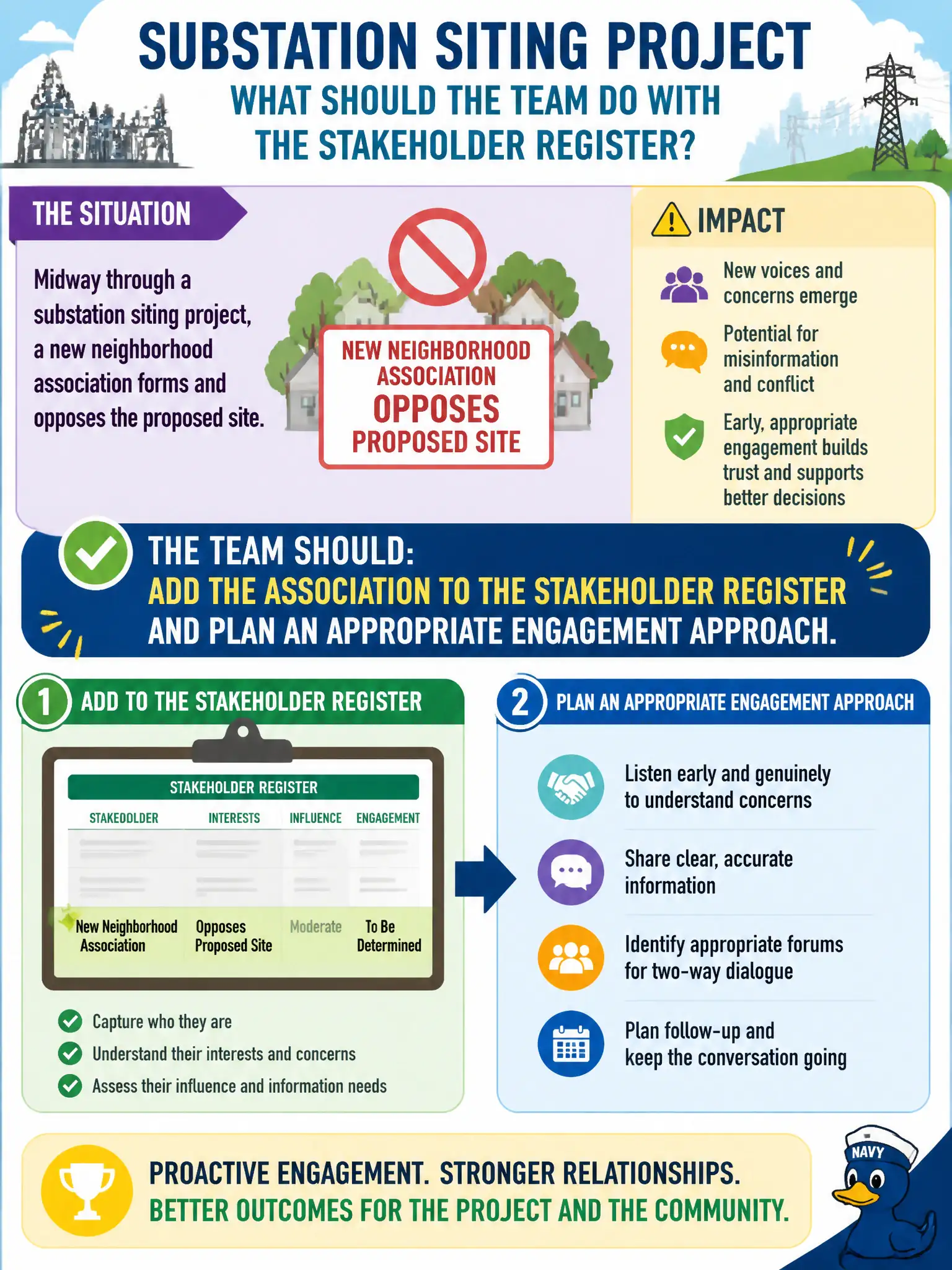
Midway through a substation siting project, a new neighborhood association forms and opposes the proposed site. What should the team do with the stakeholder register?
Select an answer to reveal the explanation.
Short Explanation
New neighbors on the block means update the address book. When a fresh association shows up swinging, write them into the stakeholder register and figure out how to engage—do not pretend the cast never changed.
Full Explanation
Stakeholder registers are living documents; when a new neighborhood association forms mid-project and opposes a substation site, the team should add the association and plan an appropriate engagement approach. Ignoring the association until closeout because registers cannot change after the charter fails by concept: charters authorize projects; they do not freeze the stakeholder landscape for the project’s duration. Deleting quieter stakeholders to keep the register the same length fails because arbitrary length control is not a stakeholder management principle and erases needed engagement data. Moving the association only into the risk register and never recording them as stakeholders fails because opposition may create risks, but the group itself must still be recognized and engaged as stakeholders. Exam caveat: CAPM emphasizes identifying stakeholders throughout the project—new civic groups appearing mid-siting are classic update triggers that exams like to test. Operational check: add the association with interest and influence assessment, choose engagement such as meetings, information sessions, and feedback channels, and link related risks or issues without using the risk register as a substitute for stakeholder recording.