
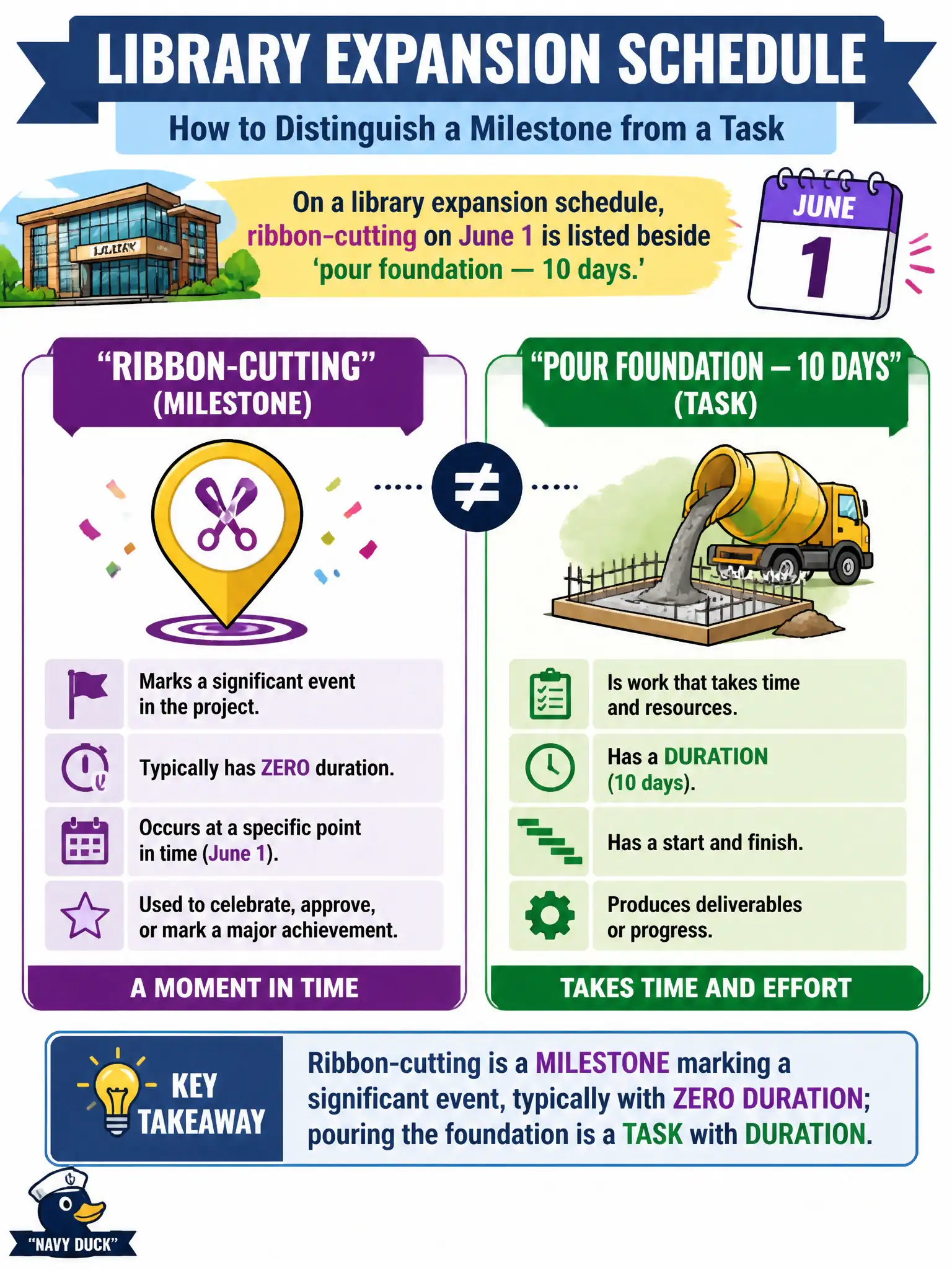
On a library expansion schedule, ribbon-cutting on June 1 is listed beside 'pour foundation — 10 days.' How should those two items be distinguished?
Select an answer to reveal the explanation.
Short Explanation
A milestone is a flag in the ground—'we opened'—not the hours of digging that got you there. The ten-day pour is the work; ribbon-cutting is the celebration checkpoint.
Full Explanation
A milestone marks a significant event and typically has zero duration; a task (activity) has duration and consumes resources. On a library expansion schedule, ribbon-cutting on June 1 is a milestone, while “pour foundation — 10 days” is duration-bearing work that crews must perform. Saying both are milestones because any public calendar date must have zero duration fails by concept: public dates can be milestones, but foundation pouring is work that consumes time and resources and cannot be modeled as a zero-duration event. Saying pouring the foundation is a milestone and ribbon-cutting is a summary task that always consumes ten days reverses the definitions and invents duration for a ceremonial event. Saying milestones and tasks are the same once the sponsor approves the charter fails because charter approval does not collapse schedule element types or erase the need to distinguish events from work. Exam caveat: CAPM schedule literacy expects zero-duration milestones versus activities with duration—ribbon-cuttings, approvals, and openings are classic milestone examples on civic builds. Operational check: model ribbon-cutting as a 0-duration milestone successor to prerequisite work, keep foundation pour as a timed activity with resources, and verify the public date aligns to the network logic rather than floating as an unlinked wish.