
City council asks whether choosing an adaptive approach means the permitting-app team will do no planning. What is the accurate response?
Select an answer to reveal the explanation.
Short Explanation
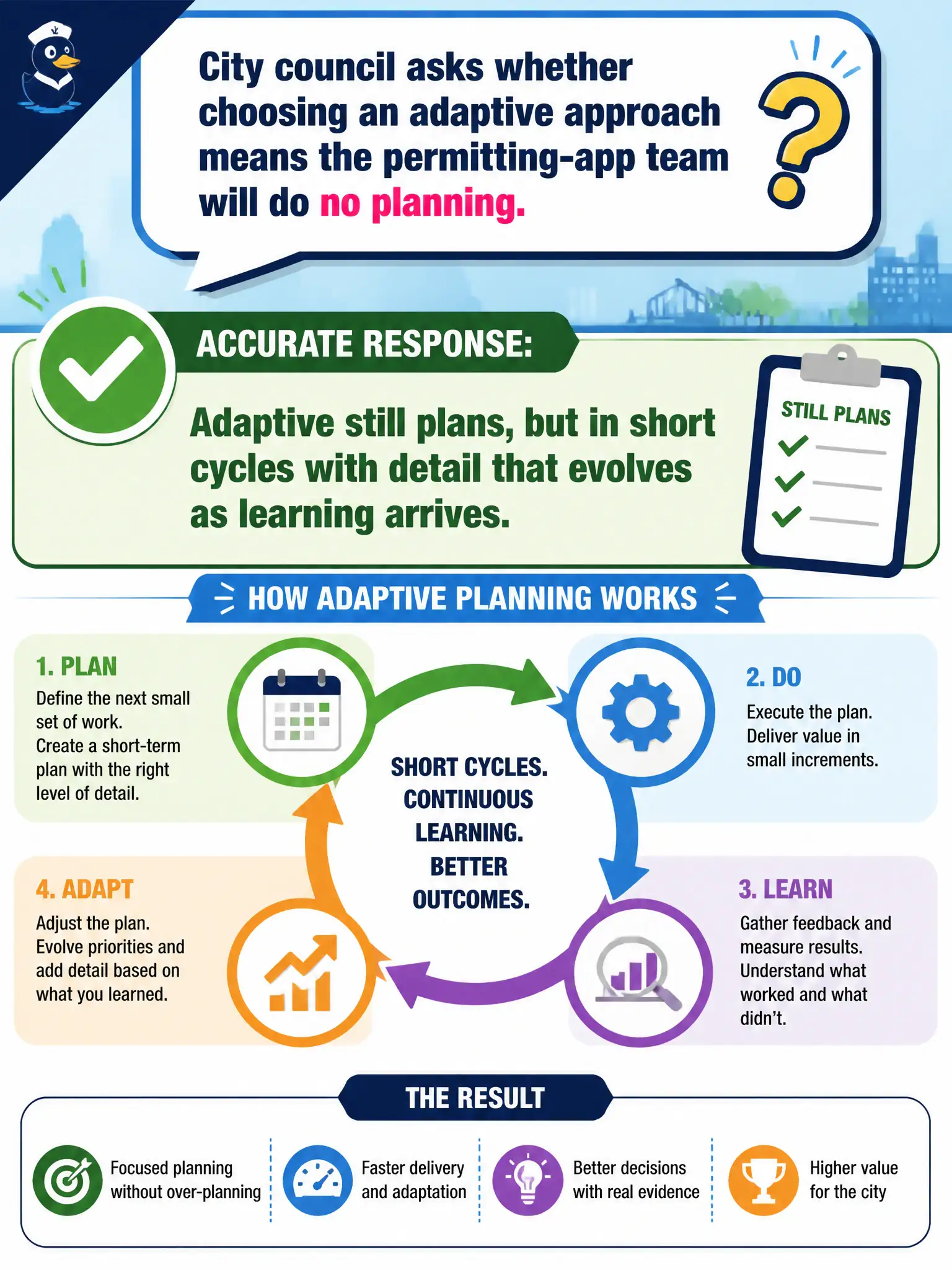
Adaptive is not “wing it.” Teams still plan—they just plan the next slice, learn, and replan. Think trail maps you redraw after each hike, not a blank page.
Full Explanation
Adaptive approaches still plan; they plan in shorter cycles with detail that evolves as learning arrives. Choosing adaptive for a permitting app does not mean the team does no planning. Saying adaptive means no planning, baselines, or prioritization at all fails by concept: adaptive teams still prioritize backlogs, plan iterations, and may use lightweight baselines appropriate to the approach. Saying adaptive forbids any near-term plan and only allows year-long predictive schedules fails because that describes a misunderstanding—adaptive emphasizes near-term detailed planning and less distant detail, not a ban on planning or a mandate for year-long predictive schedules. Saying adaptive replaces all planning with unmanaged daily improvisation fails because improvisation without backlog discipline and cycle goals is not an adaptive delivery approach. Exam caveat: CAPM predictive-versus-adaptive items often include the distractor that agile or adaptive equals no plan; the correct nuance is rolling planning and emergent detail. Operational check: show council a cadence of iteration plans, prioritized backlog, and near-term forecasts, clarifying which commitments are firm for the next cycle versus provisional for later horizons.