
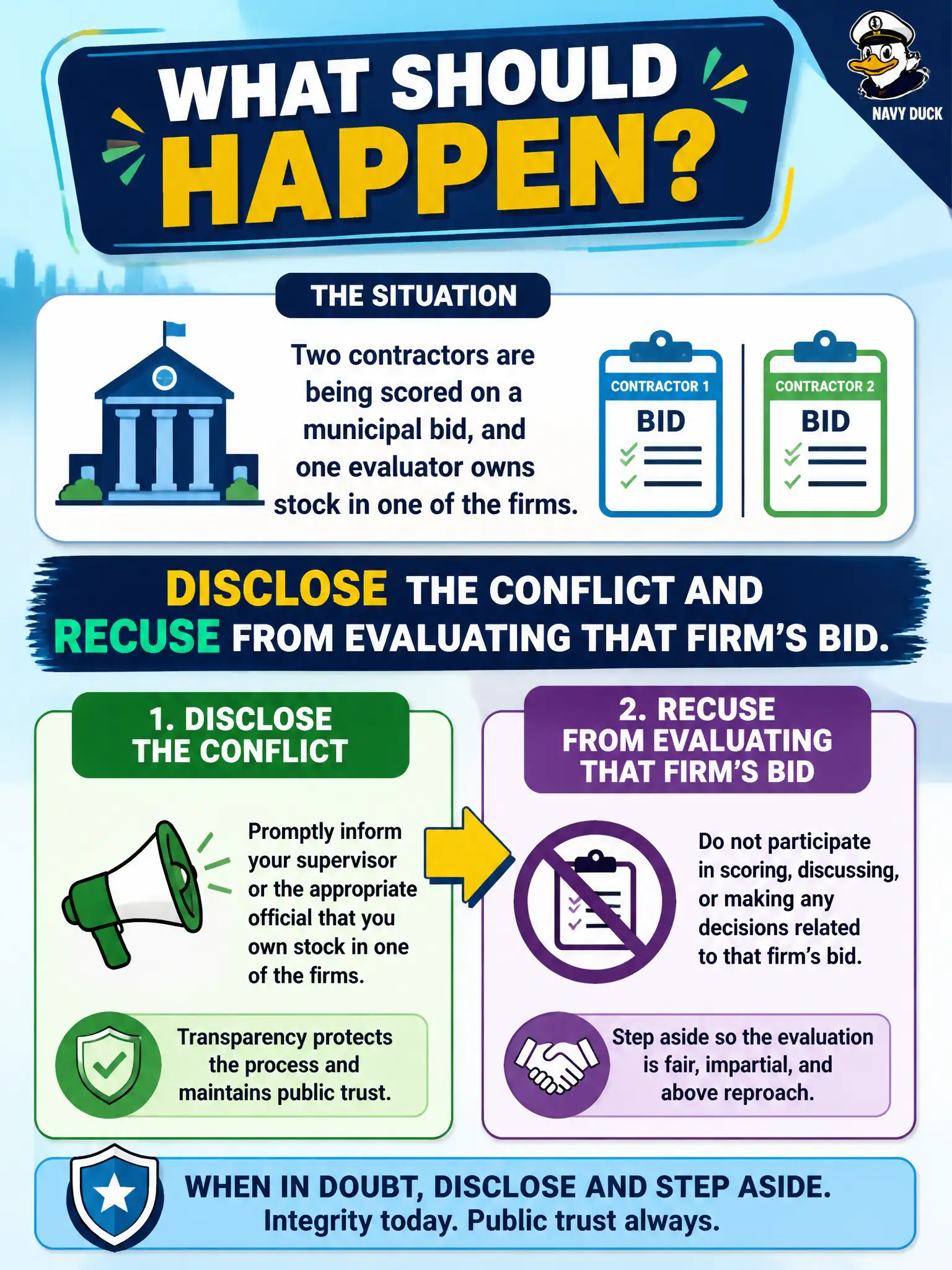
Two contractors are being scored on a municipal bid, and one evaluator owns stock in one of the firms. What should happen?
Select an answer to reveal the explanation.
Short Explanation
Owning stock in a bidder while scoring that bid is a classic conflict of interest. Disclose it and step aside—fairness means the evaluation has to look clean and be clean.
Full Explanation
Conflicts of interest must be disclosed and managed; an evaluator who owns stock in one of two municipal bidders should disclose the conflict and recuse from evaluating that firm’s bid. Keeping score without comment because stock ownership is private fails by concept: private financial interest does not remove the duty to disclose when evaluating public awards that affect resident funds. Increasing that firm’s score to protect the investment fails because it is biased decision-making for personal gain and corrupts competitive fairness. Awarding both contracts to avoid choosing under a conflict fails because dual award is not a substitute for removing the conflicted evaluator and running a fair single competitive process aligned to the solicitation. Exam caveat: CAPM/PMI ethics emphasize responsibility and fairness in procurement—disclosure plus recusal (or other documented mitigation) is the expected pattern, not silence or compensatory over-awards. Operational check: require written disclosure, remove the conflicted evaluator from scoring that firm and related deliberations as policy requires, document the recusal in the procurement file, and complete evaluation with unconflicted scorers.