
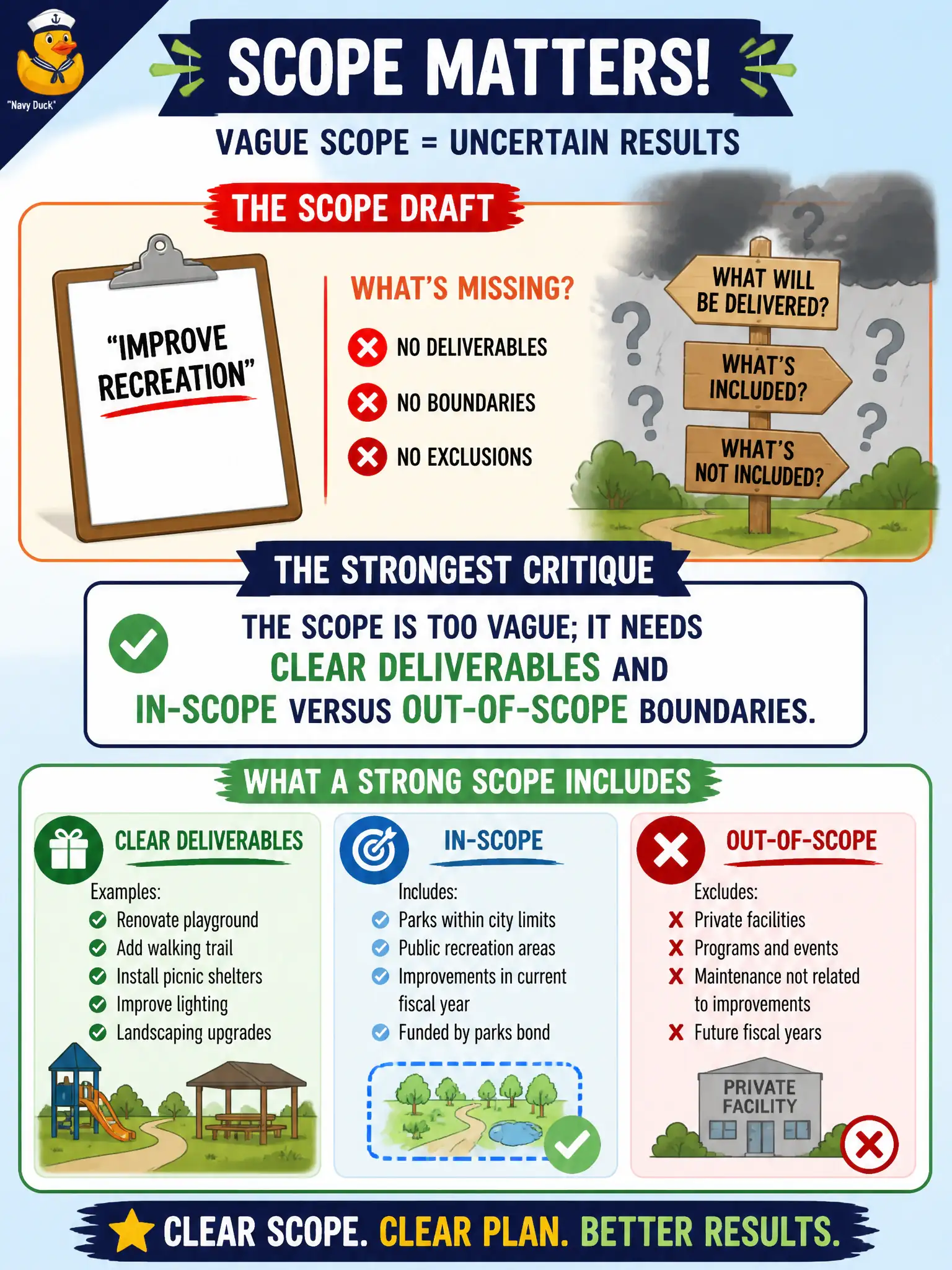
A parks director drafts project scope that only says “improve recreation” with no deliverables, boundaries, or exclusions. What is the strongest critique?
Select an answer to reveal the explanation.
Short Explanation
“Improve recreation” sounds nice on a flyer and useless on a project. Without deliverables and clear in/out boundaries, nobody knows what “done” means—and every new idea can sneak in.
Full Explanation
Adequate project scope defines what will and will not be delivered so the team can plan and control work. A parks statement that only says “improve recreation” without deliverables, boundaries, or exclusions is too vague and needs clear deliverables plus in-scope versus out-of-scope boundaries. Claiming vague wording is fine because recreation projects never need measurable outcomes fails by concept: public projects still require measurable scope to authorize cost and schedule. Saying scope should list only funding codes and omit any description of work fails because funding codes identify money sources—they do not define the product or service to be delivered. Claiming the slogan is already a complete WBS fails because a WBS decomposes defined scope into work packages; a vague phrase is not a WBS and cannot drive packages or control accounts. Exam caveat: CAPM scope questions reward specificity—deliverables, acceptance criteria, and exclusions—over slogans that sound civic-minded but cannot be controlled or accepted. Operational check: rewrite scope with named deliverables (for example trail segments, playground equipment lists), explicit exclusions, and acceptance criteria, then obtain sponsor confirmation before detailed estimating begins.