
A hybrid city project moves a data center with a predictive plan while building a resident portal UX with adaptive sprints. How should BA work be applied?
Select an answer to reveal the explanation.
Short Explanation
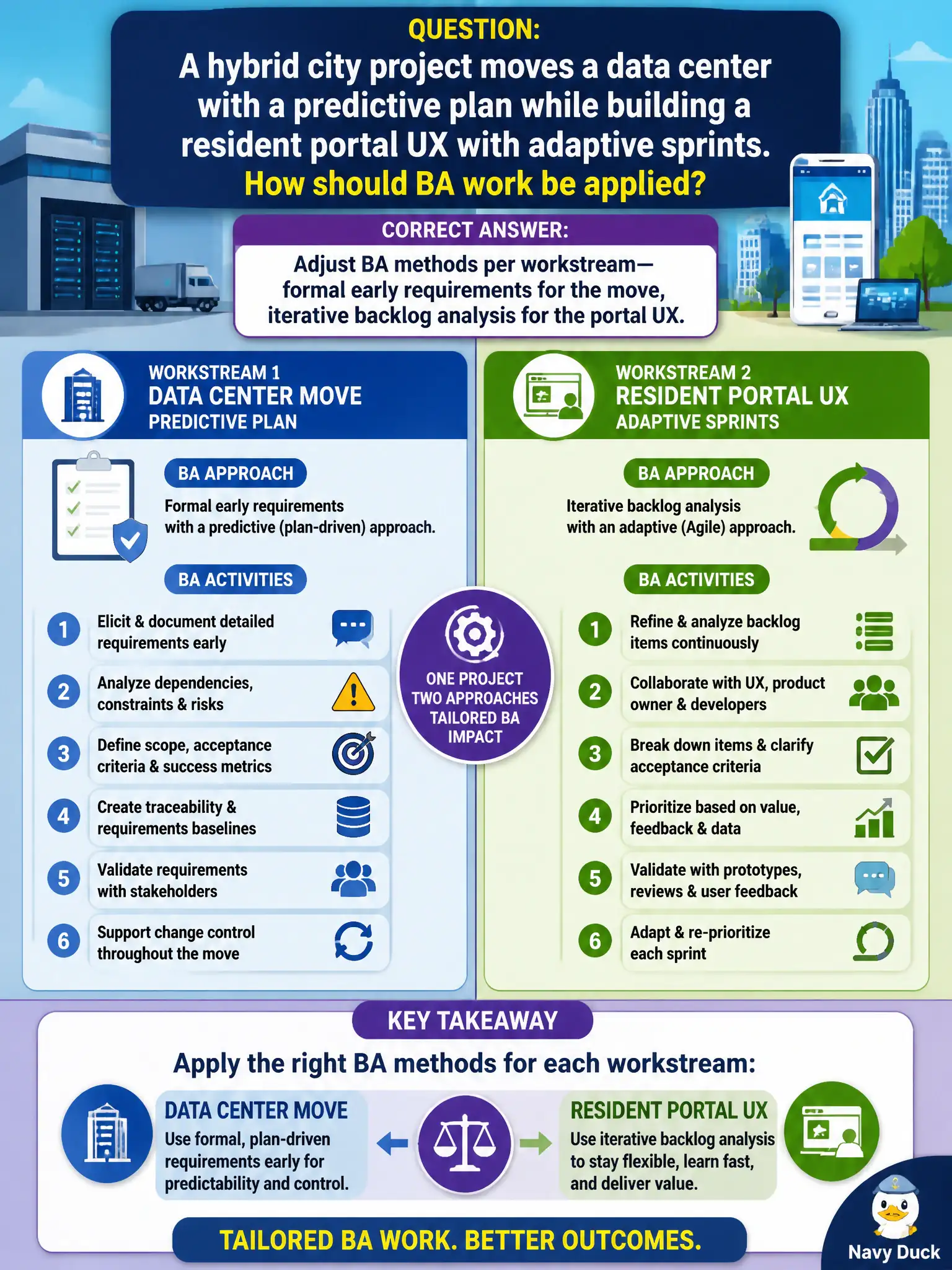
Hybrid is mix-and-match, not one-size-fits-all. Treat the data-center move like a planned cutover with formal requirements, and treat the portal UX like a backlog you keep grooming—BA follows each workstream’s method.
Full Explanation
A hybrid city project that moves a data center with a predictive plan while building a resident portal UX with adaptive sprints should adjust BA methods per workstream—formal early requirements for the move, iterative backlog analysis for the portal UX. Hybrid civic programs succeed when analysis matches the nature of each stream instead of forcing one method onto both. Rack moves and portal UX discovery have different uncertainty and change profiles.
Using only predictive BRDs for the portal and ignoring backlog refinement fails conceptually because adaptive UX work needs iterative backlog analysis, not only early heavyweight specs. Applying adaptive story workshops to data-center rack moves fails because physical move sequencing and constraints often need predictive planning artifacts more than story slicing. Dropping BA from the predictive stream because hybrid projects need no analysis fails because predictive streams still require clear requirements and acceptance for a successful move.
Exam caveat: Hybrid approaches call for method fit per workstream, not a single BA style for the whole program. Operational check: maintain formal early requirements and change control for the data-center move, run iterative backlog refinement for the portal UX, and document in the hybrid plan which BA cadence applies to which stream.