
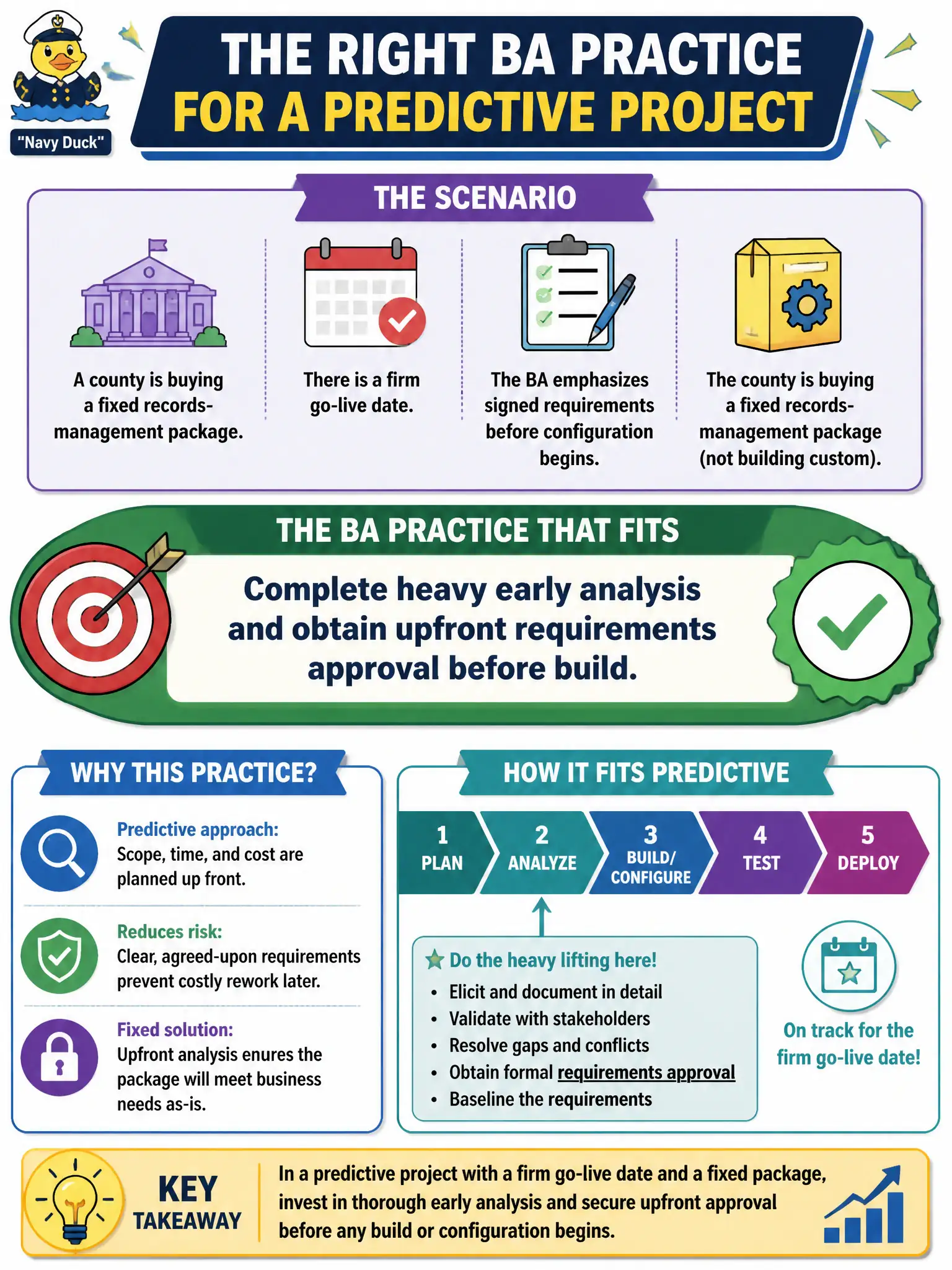
A county is buying a fixed records-management package with a firm go-live date. The BA emphasizes signed requirements before configuration begins. Which BA practice fits this predictive context?
Select an answer to reveal the explanation.
Short Explanation
When the package and date are locked, you do the homework first—get agreement on what “done” means before anyone configures. That upfront sign-off is classic predictive BA, not optional paperwork for fun.
Full Explanation
A county buying a fixed records-management package with a firm go-live date fits predictive BA practice: complete heavy early analysis and obtain upfront requirements approval before configuration begins. Signed requirements reduce rework against a vendor package and a hard civic date, giving clear acceptance targets for records migration and access rules. Early approval is appropriate when change after configuration is expensive and calendar-bound.
Skipping sign-off and refining requirements only after go-live fails conceptually because post-go-live refinement on a fixed package with a firm date invites noncompliance and emergency change. Replacing all requirements documents with daily standup notes only fails because standup notes are coordination aids, not approved requirements baselines for vendor configuration. Treating vendor demos as the sole acceptance record with no written requirements fails because demos without written criteria leave acceptance subjective and weak under audit.
Exam caveat: Predictive package implementations with firm dates emphasize upfront approved requirements before build or configuration. Operational check: finish records-management requirements, obtain formal approval before configuration, link key rules to tests in an RTM or equivalent, and refuse to treat standup notes or demos alone as the acceptance baseline.