
An adaptive parks product uses a dated roadmap. What misconception should leaders avoid?
Select an answer to reveal the explanation.
Short Explanation
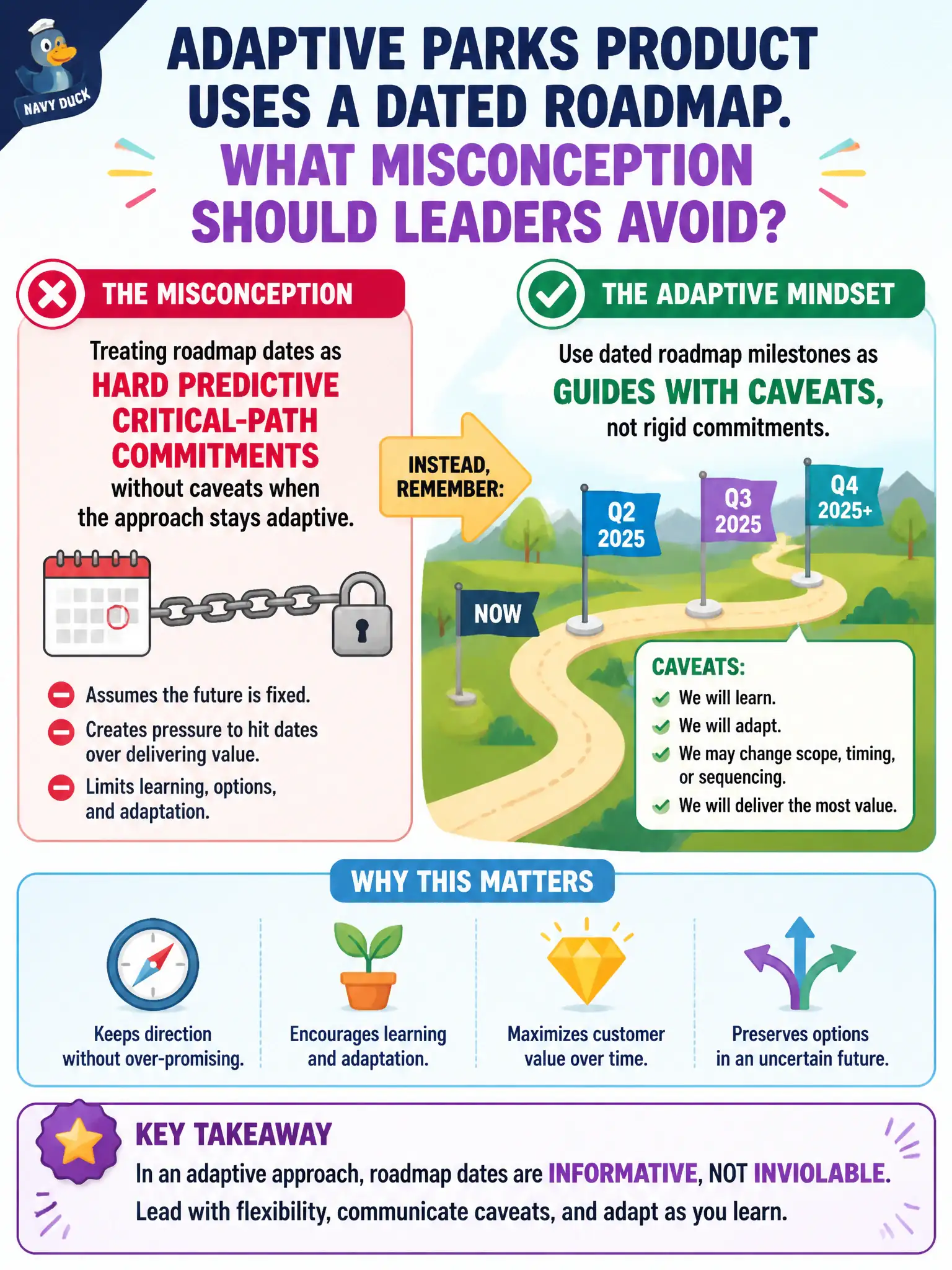
A roadmap date is more like a weather forecast than a train timetable carved in stone—useful direction, still allowed to shift when learning lands. Don’t lock adaptive work into fake certainty.
Full Explanation
An adaptive parks product that uses a dated roadmap must avoid treating roadmap dates as hard predictive critical-path commitments without caveats when the approach stays adaptive. Dates on adaptive roadmaps communicate intent and windows; they are not automatic predictive baselines unless the organization explicitly converts them through governance. Leaders who treat every roadmap date as immovable critical-path law create false certainty and punitive replanning that harms adaptive learning.
Claiming roadmaps can never mention time periods fails conceptually because time horizons are a normal roadmap element; the issue is over-hardening them into predictive commitments. Claiming adaptive teams must convert every roadmap theme into a fixed predictive critical path with no caveats fails because that conversion abandons adaptive planning. Saying stakeholders should be told nothing about direction until the final release ships fails because silence removes the roadmap’s communication purpose entirely.
Exam caveat: In adaptive contexts, roadmap timing is directional unless formally baselined; do not silently equate it to predictive critical-path commitment. Operational check: label parks roadmap dates with adaptive caveats, educate leaders that windows may move with learning and capacity, and use predictive critical-path commitments only where the life cycle and governance actually require them.