
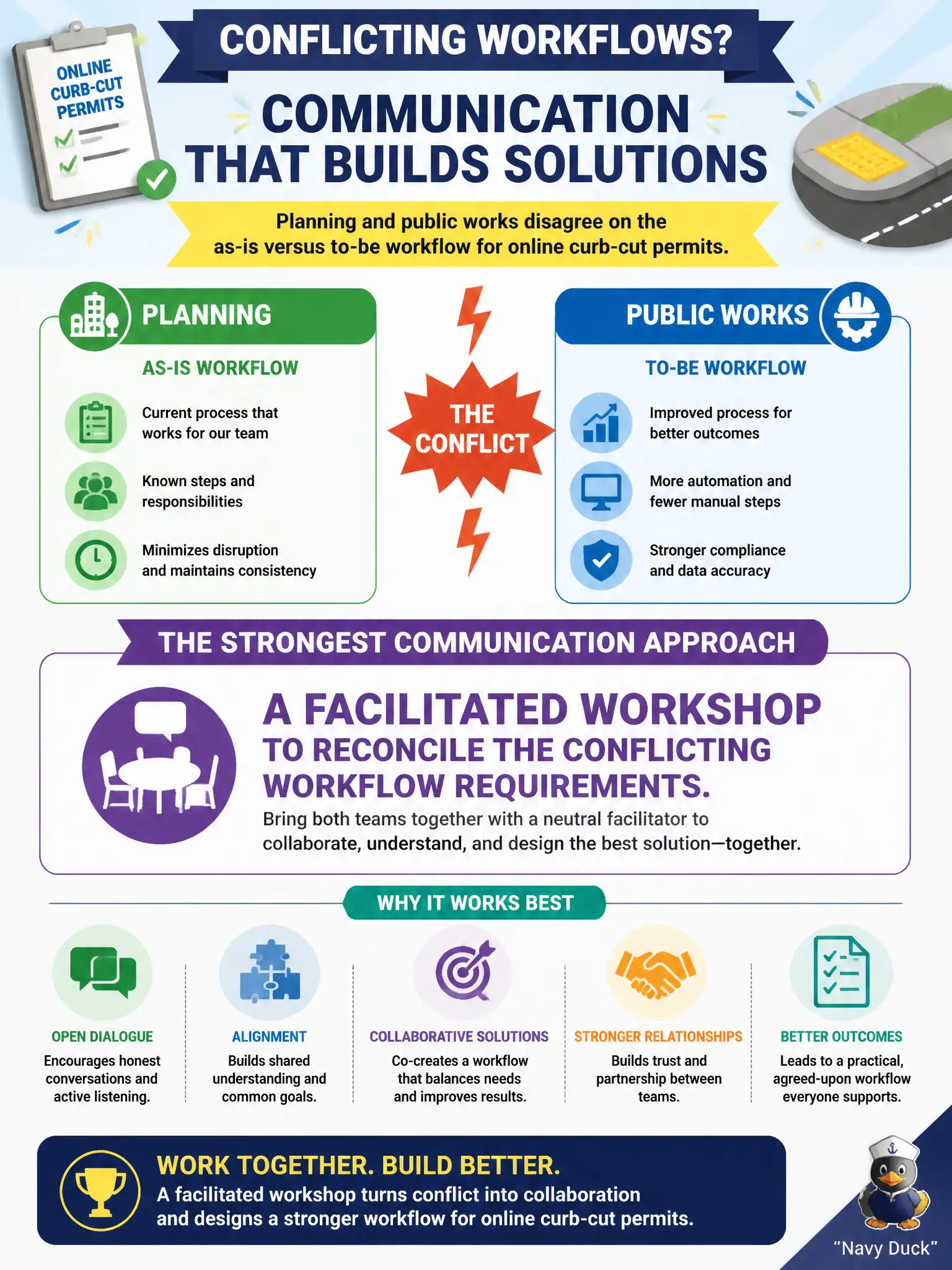
Planning and public works disagree on the as-is versus to-be workflow for online curb-cut permits. Which communication approach is strongest for resolving the conflict?
Select an answer to reveal the explanation.
Short Explanation
Email votes are like arguing through sticky notes on a locked door. When departments clash on workflow, put them in a facilitated workshop and draw the process together.
Full Explanation
When planning and public works disagree on as-is versus to-be workflow for online curb-cut permits, the strongest communication approach is a facilitated workshop that reconciles conflicting workflow requirements into a shared model. Facilitation surfaces assumptions, draws process steps together, and produces a decision trail suitable for municipal delivery. Asynchronous votes and silent markups rarely resolve deep process conflict.
Email voting on isolated requirement bullets without discussion fails conceptually because voting freezes positions without exploring process logic or dependencies between steps. A silent document markup period with no facilitated dialogue fails because parallel edits without dialogue amplify disagreement rather than converging on one workflow. Assigning the conflict randomly to whichever director replies first in chat fails because first-reply wins is not governance and produces brittle, contestable decisions.
Exam caveat: Conflict on process requirements calls for facilitated reconciliation, not convenience voting or chat races. Operational check: schedule a facilitated curb-cut workflow workshop with planning and public works, produce an agreed as-is/to-be diagram, and baseline or backlog the reconciled requirements before further portal configuration.