
A public-records request tracker uses an adaptive task board. What should the columns primarily represent?
Select an answer to reveal the explanation.
Short Explanation
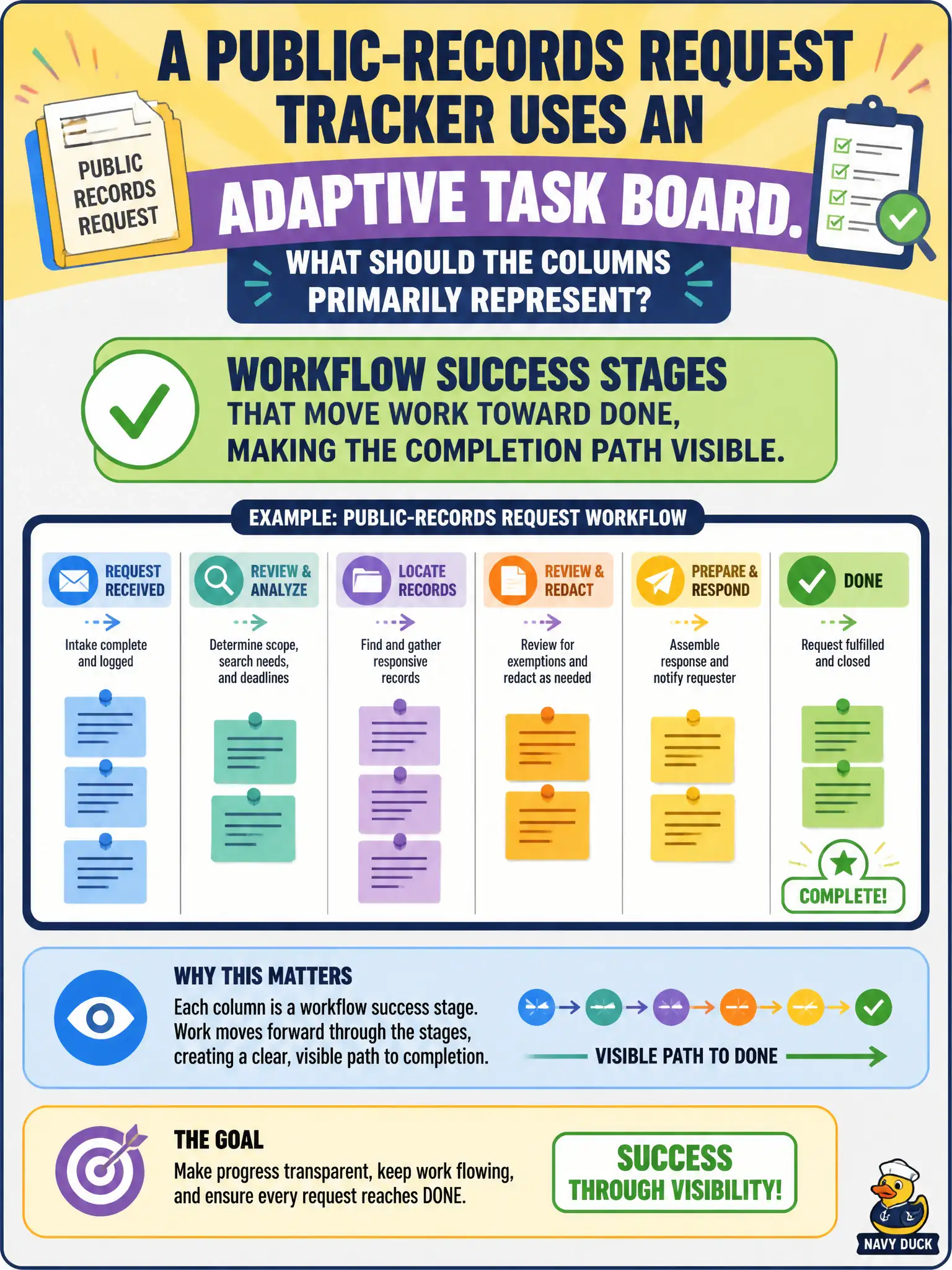
Board columns are the assembly line signs—Request, In Progress, Review, Done—not random office trivia. They show the path to finished work so bottlenecks stick out. If a card’s stuck, the column tells you where success stalled.
Full Explanation
On a public-records request tracker using an adaptive task board, columns should primarily represent workflow success stages that move work toward Done, making the completion path visible. Board columns visualize states in the delivery flow—such as Ready, In Progress, Review, and Done—so the team can manage flow and see where requests stall on the civic records path. Clear stages turn the board into a control surface for completion, not a decorative filing chart.
Employee personality types unrelated to delivery flow fail conceptually because personality labels are not workflow stages toward Done. Alphabetical filing codes from the records warehouse only fail because warehouse filing codes are storage schemes, not adaptive completion stages on a delivery task board. Fiscal year budget accounts with no workflow meaning fail because budget codes do not describe how work progresses to Done.
Exam caveat: Adaptive board columns model workflow toward Done—not personalities, warehouse alphabets, or budget accounts. Operational check: redefine the records tracker columns as clear workflow stages, set WIP limits if using Kanban habits, and ensure "Done" means accepted completion for each public-records request item.