
A county records office has continuous intake of digitization requests with no versioned release train, while a separate team ships a citizen app on a cadence of planned releases. Which methodology-component fit is most appropriate?
Select an answer to reveal the explanation.
Short Explanation
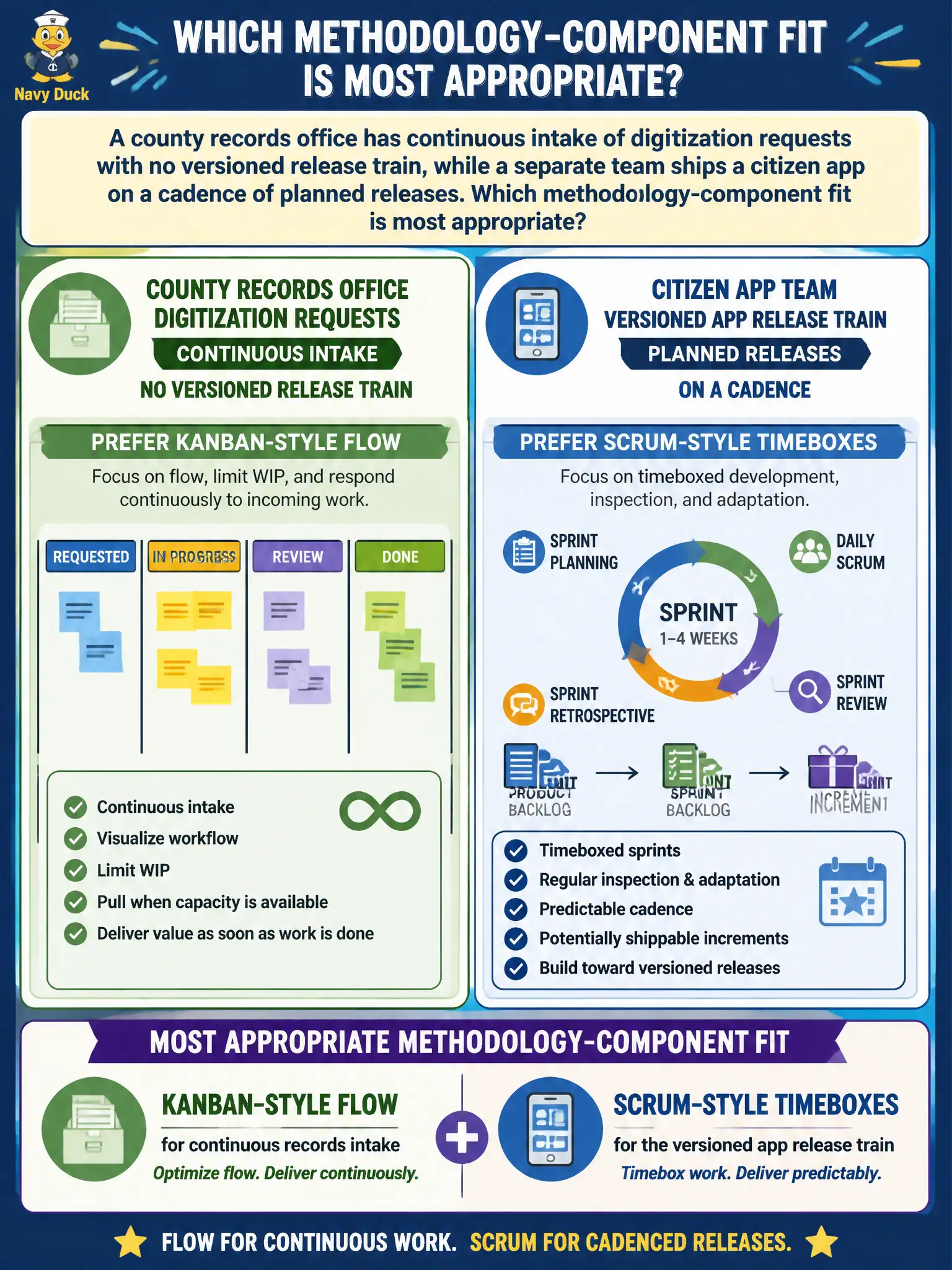
Steady incoming paper piles love flow-and-WIP thinking; a versioned app loves sprint-shaped release trains. Match the method to the work shape instead of one-size-fits-all. That is CAPM "distinguish components" in plain clothes.
Full Explanation
A county records office with continuous intake of digitization requests and no versioned release train fits Kanban-style flow, while a separate team shipping a citizen app on a cadence of planned releases fits Scrum-style timeboxes. Preferring Kanban for continuous records intake and Scrum for the versioned app release train matches methodology components to work characteristics rather than forcing one system onto both civic workloads.
Forcing Scrum sprints on the continuous intake desk and Kanban-only flow on the versioned release train with no events fails conceptually because it mismatches cadence needs: continuous intake rarely benefits from artificial sprint batches, and a versioned release train typically needs planning and review events. Requiring SAFe® Program Increment planning as the only option for both work types fails because scaling PI planning is not the only—or always appropriate—fit. Using predictive critical-path float as the sole control for both continuous intake and app releases fails by ignoring adaptive flow and iteration options suited to those digital workloads.
Exam caveat: Methodology-component fit is contextual—flow versus timeboxed releases—not a single mandatory framework for every municipal queue. Operational check: run records intake on a WIP-limited board; run the citizen app with sprint planning, review, and release cadence; and explain the dual design to leadership.