
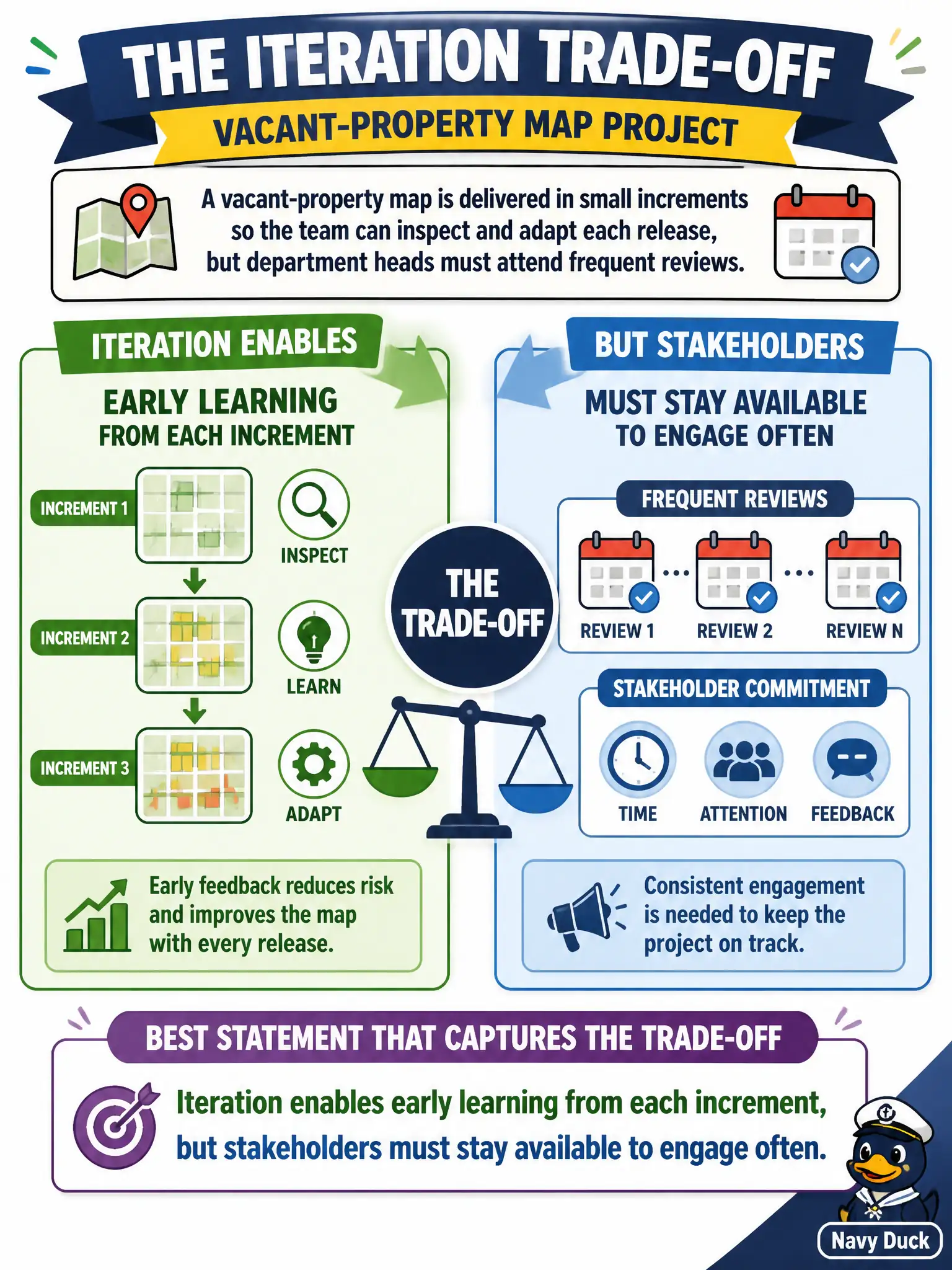
A vacant-property map is delivered in small increments so the team can inspect and adapt each release, but department heads must attend frequent reviews. Which statement best captures that trade-off?
Select an answer to reveal the explanation.
Short Explanation
Shipping map updates often is great—until nobody from the business shows up to react. Iteration’s upside is early learning; the tax is regular stakeholder time. Skip that engagement and the feedback engine stalls.
Full Explanation
Delivering a vacant-property map in small increments so the team can inspect and adapt each release—while department heads must attend frequent reviews—captures a core iteration trade-off: iteration enables early learning from each increment, but stakeholders must stay available to engage often. CAPM expects candidates to recognize both sides: early learning versus the demand for ongoing stakeholder availability on civic products.
Claiming frequent increments remove any need for stakeholder feedback forever fails conceptually because increments create more opportunities for feedback, not permission to ignore stakeholders. Claiming inspect-and-adapt only works when stakeholders refuse to attend reviews fails because refusal blocks the feedback the method needs. Claiming longer silence from stakeholders always improves adaptive outcomes fails because silence delays correction of wrong assumptions.
Exam caveat: Trade-off items reward balanced answers—benefit of early learning plus cost of stakeholder time—not one-sided myths. Operational check: schedule sustainable review cadence with department heads for the vacant-property map, protect attendance for increment demos, and adjust slice size if stakeholder capacity cannot keep up.