
A project lead is turning a proof of concept into a governed production workflow. Which approach best demonstrates roles and permissions in a IBM Certified watsonx Governance Lifecycle Advisor environment?
Select an answer to reveal the explanation.
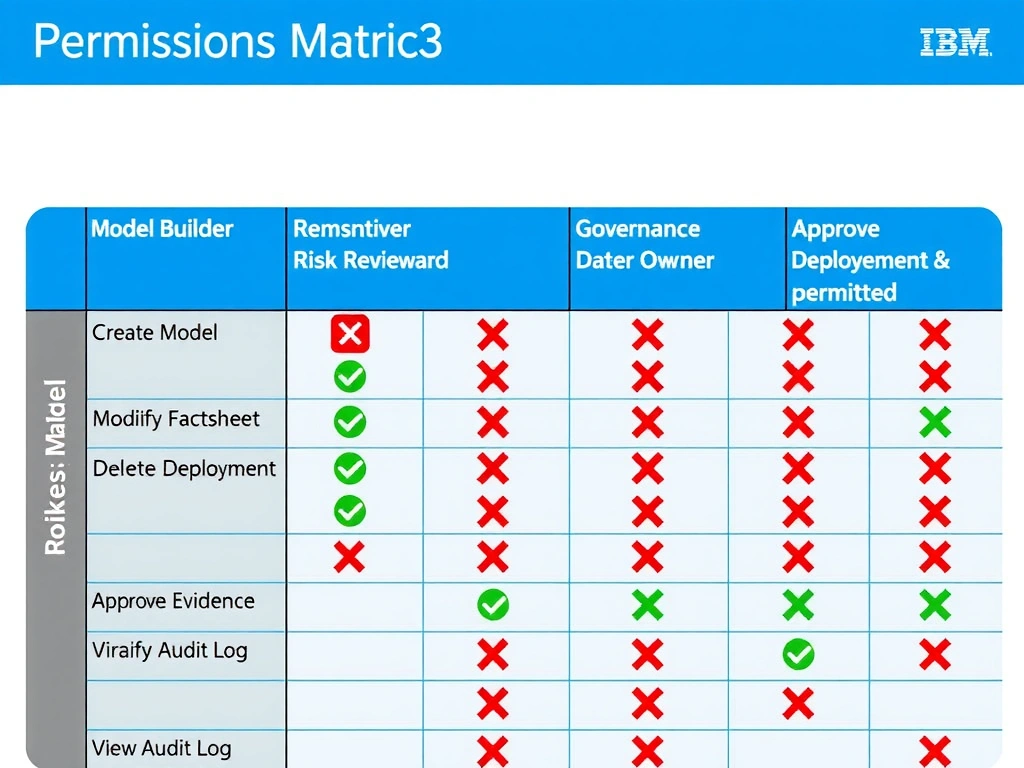
Short Explanation and Infographic
Think of roles and permissions like the nuclear-launch two-key rule: no single person can do everything unilaterally, and that is the point. Option B applies the same principle: responsibility-matched roles, separation of duties, and least privilege. Universal ownership collapses accountability. Shared admin accounts erase the audit trail. Self-approval by builders is the exact conflict of interest controls exist to prevent. Separation of duties protects everyone — option B!
Full explanation below image
Full Explanation
The correct answer is B. Assign governance roles based on responsibility, separation of duties, and least privilege. aligns directly with the 3.0 Configure watsonx.governance exam objective and reflects how IBM watsonx.governance operationalizes this practice in enterprise environments. IBM watsonx.governance is designed to provide the tooling, workflows, and evidence collection mechanisms that make AI trustworthy and auditable from intake through retirement. Choosing this option ensures the implementation is both defensible to regulators and maintainable by governance teams across the full AI lifecycle. Option A is incorrect because it applies an overbroad rule that eliminates meaningful differentiation and accountability. Option C is incorrect because it does not address the core governance requirement described in the scenario and would leave an important control gap in production. Option D is incorrect because it does not address the core governance requirement described in the scenario and would leave an important control gap in production. On scenario-based exam questions, the correct answer is consistently the one that operationalizes the IBM governance practice with structured controls rather than approximating it with shortcuts, manual workarounds, or oversimplified rules.