
After creating an AI use case in a watsonx.governance model inventory, how are AI Factsheets associated with that use case to provide lifecycle traceability?
Select an answer to reveal the explanation.
Short Explanation and Infographic
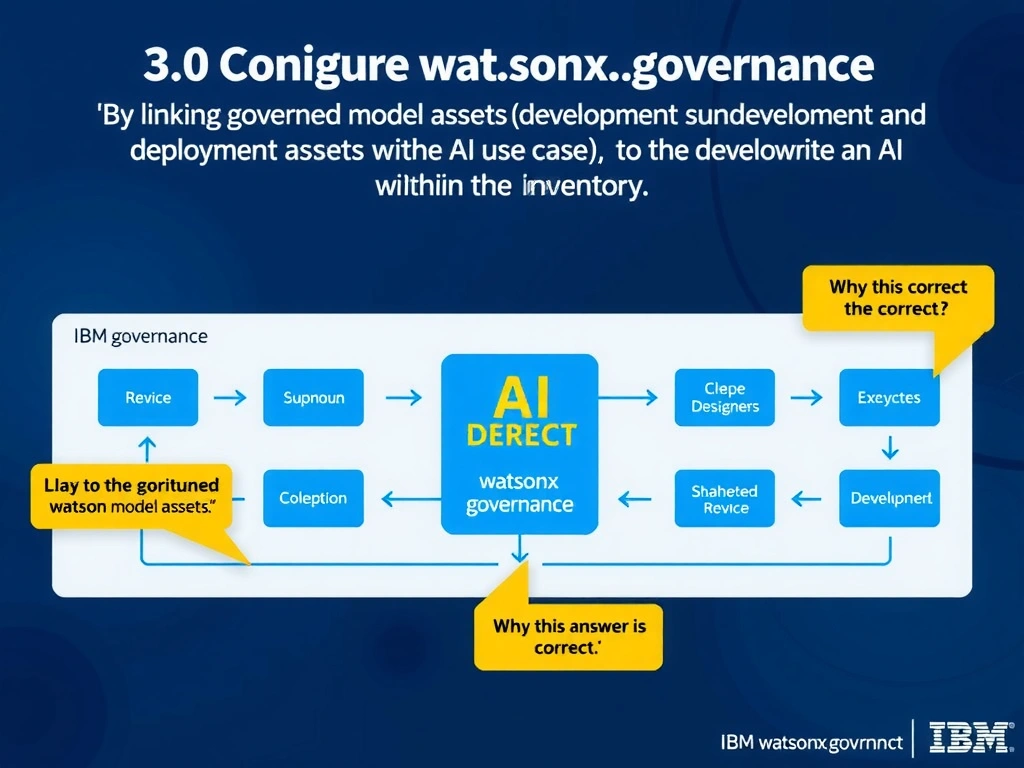
Think of it this way: in real-world AI governance, by linking governed model assets (development and deployment assets) to the ai use case within the inventory. is exactly what teams reach for when they need to handle this scenario. In watsonx. On the exam, remember that this falls squarely under the 3.0 Configure watsonx.governance domain.
Full explanation below image
Full Explanation
In watsonx.governance, AI Factsheets capture lifecycle metadata for model development and deployment assets, and traceability is established by explicitly linking those governed assets to an AI use case in the model inventory. This linkage allows stakeholders to navigate from the business use case down to specific model versions, training runs, and deployment evaluations. The association is made within the inventory interface rather than through file exports or infrastructure-level configurations. The correct answer, "By linking governed model assets (development and deployment assets) to the AI use case within the inventory.", directly addresses the scenario described because it aligns with the specific governance requirement in question. The incorrect options ("By exporting the AI Factsheet as a PDF and attaching it manually to the use case record.", "By assigning the same IBM Cloud resource group to both the AI use case and the model deployment.", "By configuring a webhook in Watson Studio that automatically pushes factsheet data to the use case on each training run.") may seem plausible but do not satisfy the core requirement. Understanding the distinction between these concepts is critical for IBM watsonx.governance implementations and is frequently tested in the 3.0 Configure watsonx.governance section of the certification exam.