
A model risk manager wants to understand where a credit underwriting model currently sits in its development cycle. Which sequence correctly represents the AI lifecycle stages in watsonx.governance?
Select an answer to reveal the explanation.
Short Explanation and Infographic
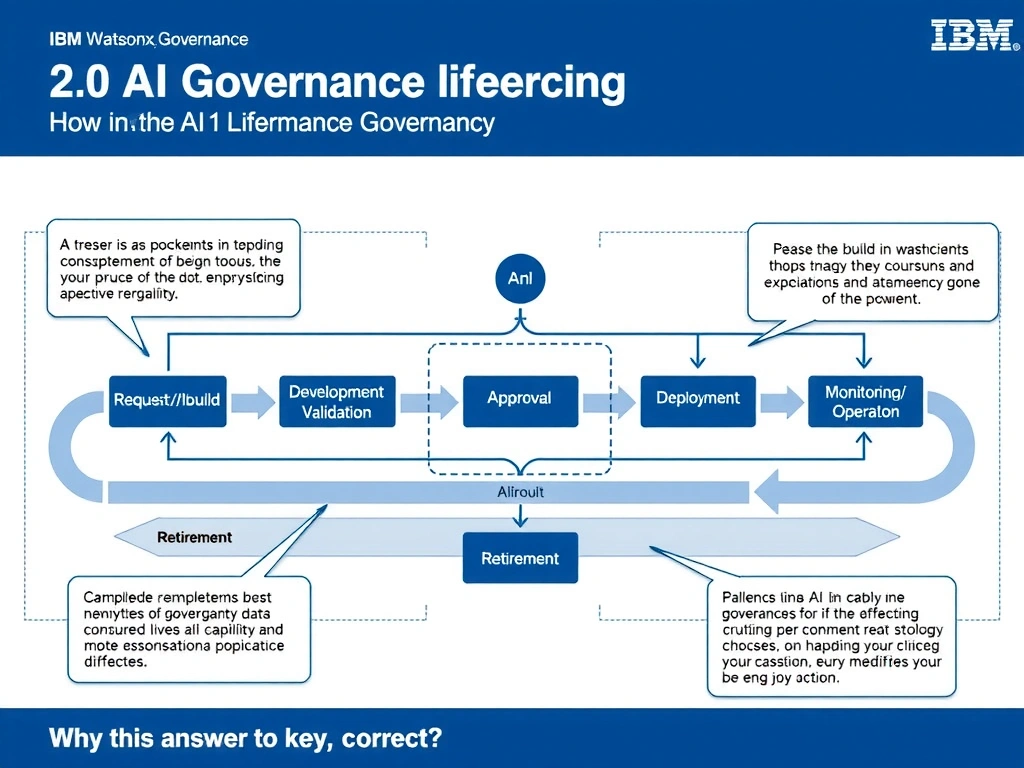
Think of it this way: in real-world AI governance, request/ideation → development/build → testing/validation → approval → deployment → monitoring/operate → retirement is exactly what teams reach for when they need to handle this scenario. watsonx. On the exam, remember that this falls squarely under the 2.0 AI Lifecycle Governance domain.
Full explanation below image
Full Explanation
watsonx.governance defines a seven-stage AI lifecycle: Request/Ideation for initial scoping, Development/Build for model creation, Testing/Validation for quality assurance, Approval as a formal governance gate, Deployment to production, Monitoring/Operate for ongoing oversight, and Retirement for end-of-life management. Each stage has distinct governance activities and triggers status changes in the use case record. Understanding this full sequence is foundational to all AI lifecycle governance activities in the platform. The correct answer, "Request/Ideation → Development/Build → Testing/Validation → Approval → Deployment → Monitoring/Operate → Retirement", directly addresses the scenario described because it aligns with the specific governance requirement in question. The incorrect options ("Design → Train → Test → Deploy → Retire", "Intake → Build → QA → Production → Sunsetting", "Proposal → Development → UAT → Release → Monitor") may seem plausible but do not satisfy the core requirement. Understanding the distinction between these concepts is critical for IBM watsonx.governance implementations and is frequently tested in the 2.0 AI Lifecycle Governance section of the certification exam.