
A financial services firm tracks their credit scoring model from development through deployment in watsonx.governance. A risk officer needs an internal artifact that auto-captures lifecycle metadata and serves as a structured nutritional label for governance review. Which artifact should the data scientist provide?
Select an answer to reveal the explanation.
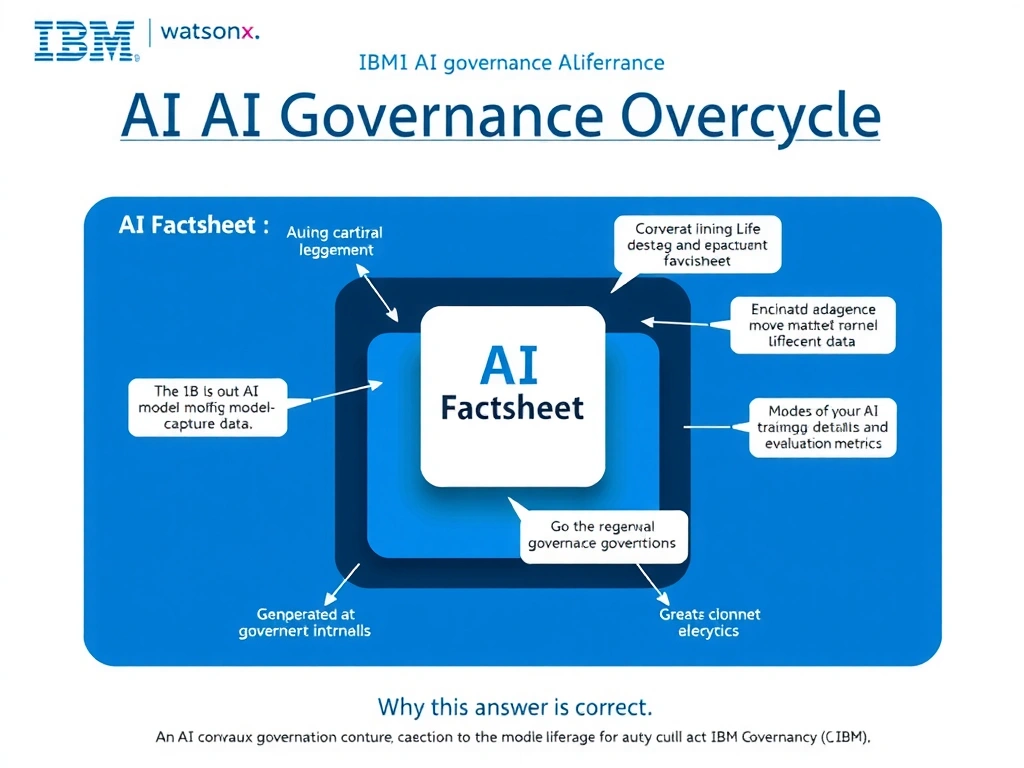
Short Explanation and Infographic
Think of it this way: in real-world AI governance, ai factsheet — ibm's internal governance artifact that auto-captures model lifecycle data including training details and evaluation metrics is exactly what teams reach for when they need to handle this scenario. AI Factsheets are IBM's internal governance artifacts that auto-capture lifecycle data and serve as the model's nutritional label. On the exam, remember that this falls squarely under the 1.0 AI Governance Overview domain.
Full explanation below image
Full Explanation
AI Factsheets are IBM's internal governance artifacts that auto-capture lifecycle data and serve as the model's nutritional label. Model cards are externally published consumer documents generated FROM the Factsheet. The correct answer, "AI Factsheet — IBM's internal governance artifact that auto-captures model lifecycle data including training details and evaluation metrics", directly addresses the scenario described because it aligns with the specific governance requirement in question. The incorrect options ("Model card — IBM's externally published summary document intended for consumers and external model users", "Compliance Accelerator template providing pre-loaded regulatory control mappings for the model's domain", "Bias audit report from the Fairness Monitor showing demographic parity across protected attribute groups") may seem plausible but do not satisfy the core requirement. Understanding the distinction between these concepts is critical for IBM watsonx.governance implementations and is frequently tested in the 1.0 AI Governance Overview section of the certification exam.