
An AI governance specialist is reviewing mandatory compliance obligations for high-risk AI systems under the EU AI Act. Which of the following is NOT a mandatory obligation specifically required of high-risk AI systems under the Act?
Select an answer to reveal the explanation.
Short Explanation and Infographic
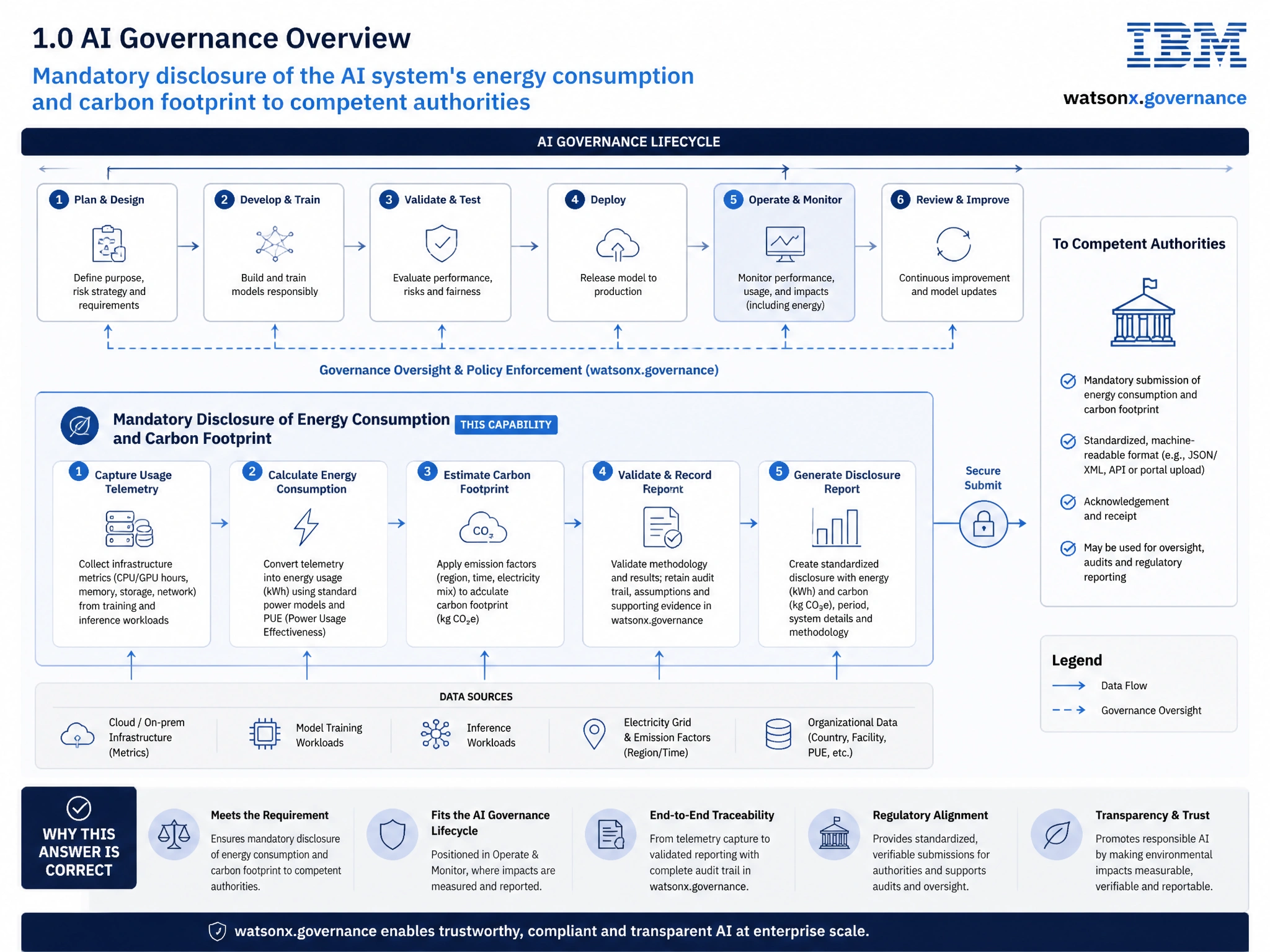
Think of it this way: in real-world AI governance, mandatory disclosure of the ai system's energy consumption and carbon footprint to competent authorities is exactly what teams reach for when they need to handle this scenario. The EU AI Act imposes a defined set of mandatory obligations on high-risk AI system providers including risk management systems, data and data governance requirements, technical documentation under Article 11, logging and record-keeping, transparency and provision of information to deployers, human oversight measures, and accuracy and cybersecurity standards. On the exam, remember that this falls squarely under the 1.0 AI Governance Overview domain.
Full explanation below image
Full Explanation
The EU AI Act imposes a defined set of mandatory obligations on high-risk AI system providers including risk management systems, data and data governance requirements, technical documentation under Article 11, logging and record-keeping, transparency and provision of information to deployers, human oversight measures, and accuracy and cybersecurity standards. While the EU has separate sustainability regulatory initiatives, mandatory carbon footprint disclosure to competent authorities is not among the enumerated high-risk AI obligations in the Act's current text. Organizations must distinguish EU AI Act requirements from obligations arising under separate EU environmental legislation. The correct answer, "Mandatory disclosure of the AI system's energy consumption and carbon footprint to competent authorities", directly addresses the scenario described because it aligns with the specific governance requirement in question. The incorrect options ("Technical documentation meeting the requirements of Article 11", "Implementation of human oversight mechanisms enabling natural persons to intervene", "Registration of the high-risk AI system in the EU AI database prior to deployment") may seem plausible but do not satisfy the core requirement. Understanding the distinction between these concepts is critical for IBM watsonx.governance implementations and is frequently tested in the 1.0 AI Governance Overview section of the certification exam.