
A Series A startup wants to deploy watsonx.governance as rapidly as possible without procuring hardware or managing infrastructure and prefers pay-as-you-go pricing. They have no regulatory requirements prohibiting shared cloud infrastructure. Which deployment option is most suitable?
Select an answer to reveal the explanation.
Short Explanation and Infographic
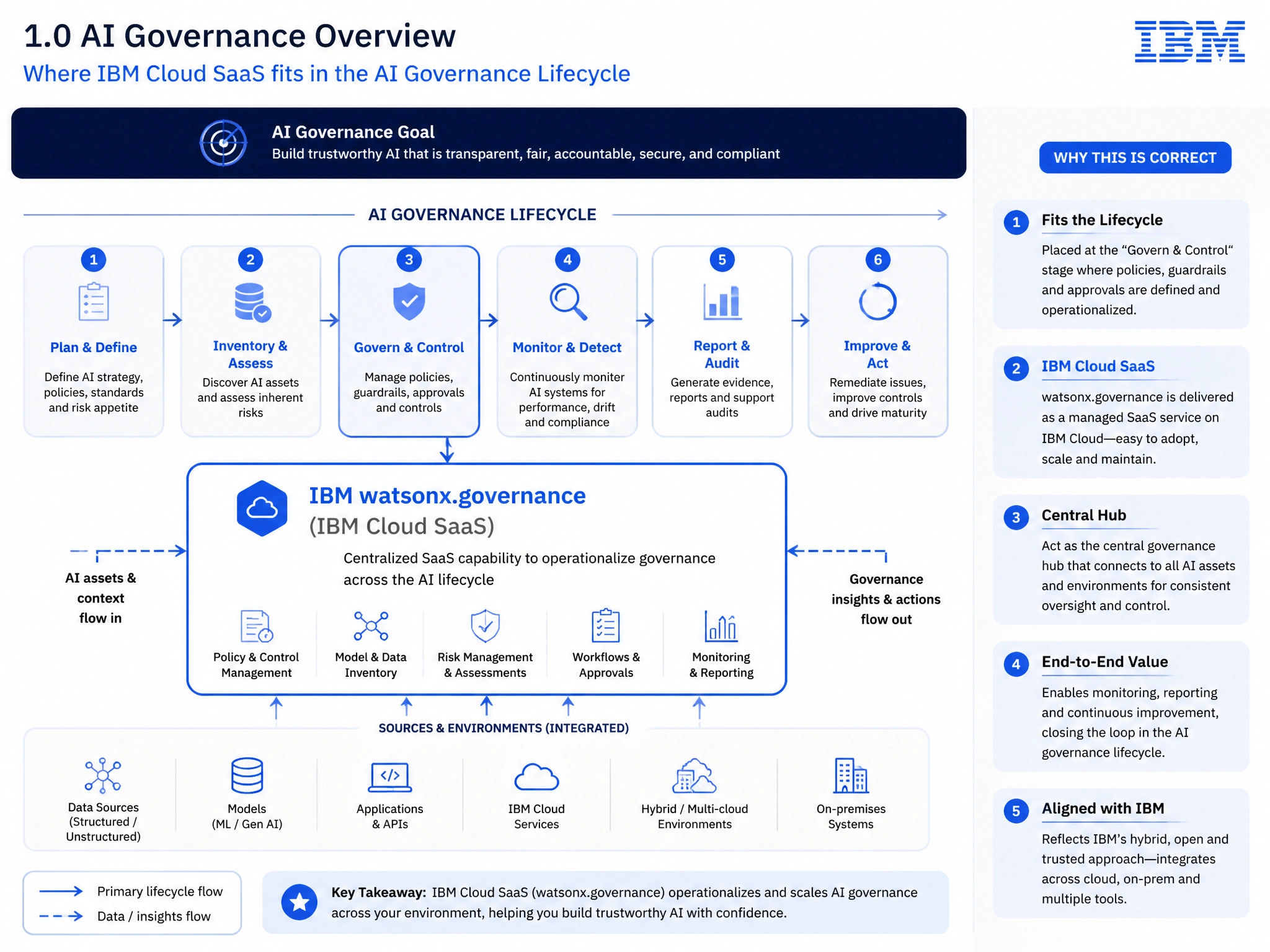
Think of it this way: in real-world AI governance, ibm cloud saas is exactly what teams reach for when they need to handle this scenario. IBM Cloud SaaS is the optimal deployment mode for organizations seeking fast time-to-value, minimal infrastructure overhead, and flexible consumption-based pricing, as IBM manages all underlying infrastructure, patching, and scaling. On the exam, remember that this falls squarely under the 1.0 AI Governance Overview domain.
Full explanation below image
Full Explanation
IBM Cloud SaaS is the optimal deployment mode for organizations seeking fast time-to-value, minimal infrastructure overhead, and flexible consumption-based pricing, as IBM manages all underlying infrastructure, patching, and scaling. This contrasts with IBM Cloud Pak for Data, which provides greater control and is preferred for on-premises or hybrid scenarios driven by data sovereignty or regulatory requirements. For startups or organizations in early AI governance maturity, SaaS reduces the operational barrier to adopting watsonx.governance. The correct answer, "IBM Cloud SaaS", directly addresses the scenario described because it aligns with the specific governance requirement in question. The incorrect options ("IBM Cloud Pak for Data on-premises", "IBM Cloud Pak for Data in a hybrid cloud configuration", "Air-gapped private cloud deployment") may seem plausible but do not satisfy the core requirement. Understanding the distinction between these concepts is critical for IBM watsonx.governance implementations and is frequently tested in the 1.0 AI Governance Overview section of the certification exam.