
A healthcare organization has a Recovery Point Objective (RPO) of 4 hours and a Recovery Time Objective (RTO) of 2 hours for their self-hosted Instana monitoring platform. Which disaster recovery approach best satisfies both requirements?
Select an answer to reveal the explanation.
Short Explanation and Infographic
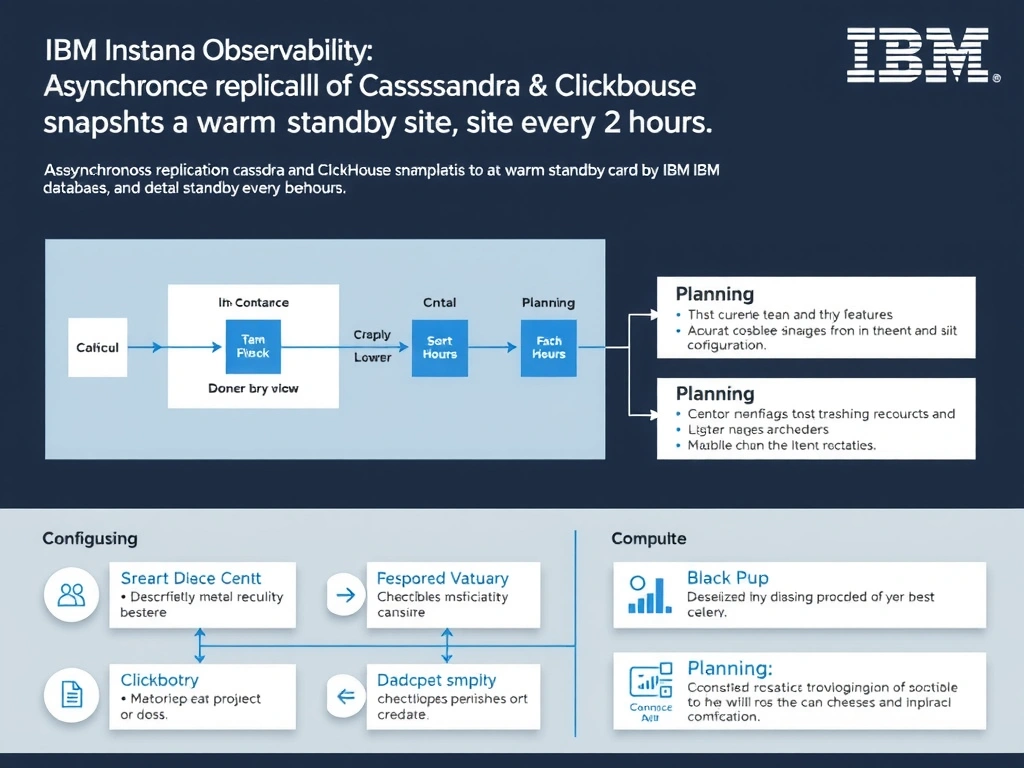
Asynchronous replication every 2 hours satisfies the 4-hour RPO since worst-case data loss is 2 hours, and a pre-provisioned warm standby site with semi-automated failover runbooks can meet the 2-hour RTO. Fully synchronous replication exceeds the stated requirements, adding significant cost and write-latency overhead. Cold backups with 8-12 hour restoration times directly violate the 2-hour RTO requirement.
Full explanation below image
Full Explanation
Asynchronous replication every 2 hours satisfies the 4-hour RPO since worst-case data loss is 2 hours, and a pre-provisioned warm standby site with semi-automated failover runbooks can meet the 2-hour RTO. Fully synchronous replication exceeds the stated requirements, adding significant cost and write-latency overhead. Cold backups with 8-12 hour restoration times directly violate the 2-hour RTO requirement. The correct answer is 'Asynchronous replication of Cassandra and ClickHouse snapshots to a warm standby site every 2 hours with semi-automated failover runbooks'. The incorrect options — 'Daily cold backups of all datastore volumes stored offsite with full manual restoration procedures estimated at 8-12 hours', 'Synchronous real-time replication of all backend components to a second site with fully automated failover achieving sub-minute RTO', 'Migrate to Instana SaaS instead of self-hosted since SaaS automatically satisfies all RPO and RTO requirements' — are wrong because they do not align with IBM Instana's architecture or recommended practices for this scenario. Understanding this concept is essential for the Domain 5: Planning domain of the IBM Instana Observability certification.