
An SRE team configures SLO targets for a Checkout Application Perspective and later discovers that synthetic health-check calls to the /health endpoint are included in the error budget calculations, artificially inflating the success rate. What is the recommended Instana approach to exclude these health-check calls from the perspective's scope?
Select an answer to reveal the explanation.
Short Explanation and Infographic
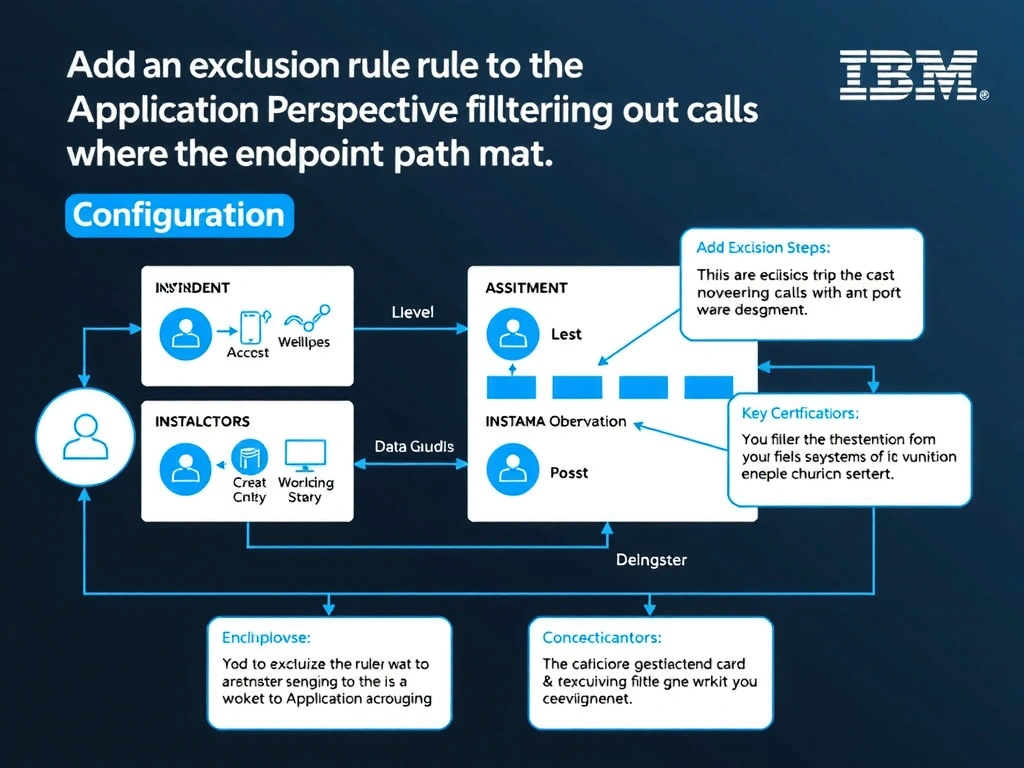
Application Perspectives support both inclusion and exclusion rules evaluated against call-level tags including the HTTP endpoint path attribute. Adding an exclusion rule matching the /health path removes those calls from the perspective's scope entirely, ensuring that SLO error budgets and throughput metrics reflect only genuine user-facing traffic. Monitoring profiles operate at the agent collection level and cannot selectively exclude by endpoint within an already-collected service.
Full explanation below image
Full Explanation
Application Perspectives support both inclusion and exclusion rules evaluated against call-level tags including the HTTP endpoint path attribute. Adding an exclusion rule matching the /health path removes those calls from the perspective's scope entirely, ensuring that SLO error budgets and throughput metrics reflect only genuine user-facing traffic. Monitoring profiles operate at the agent collection level and cannot selectively exclude by endpoint within an already-collected service. The correct answer is 'Add an exclusion rule to the Application Perspective filtering out calls where the endpoint path matches /health'. The incorrect options — 'Create a recurring maintenance window during peak health-check hours to suppress their contribution', 'Configure a monitoring profile on the Checkout service host that excludes the /health path from collection', 'Remove the health-check process from the monitoring zone associated with the Checkout service' — are wrong because they do not align with IBM Instana's architecture or recommended practices for this scenario. Understanding this concept is essential for the Domain 2: Configuration domain of the IBM Instana Observability certification.