
A project lead is turning a proof of concept into a governed production workflow. The team is focused on ACID table behavior. Which recommendation is most appropriate?
Select an answer to reveal the explanation.
Short Explanation and Infographic
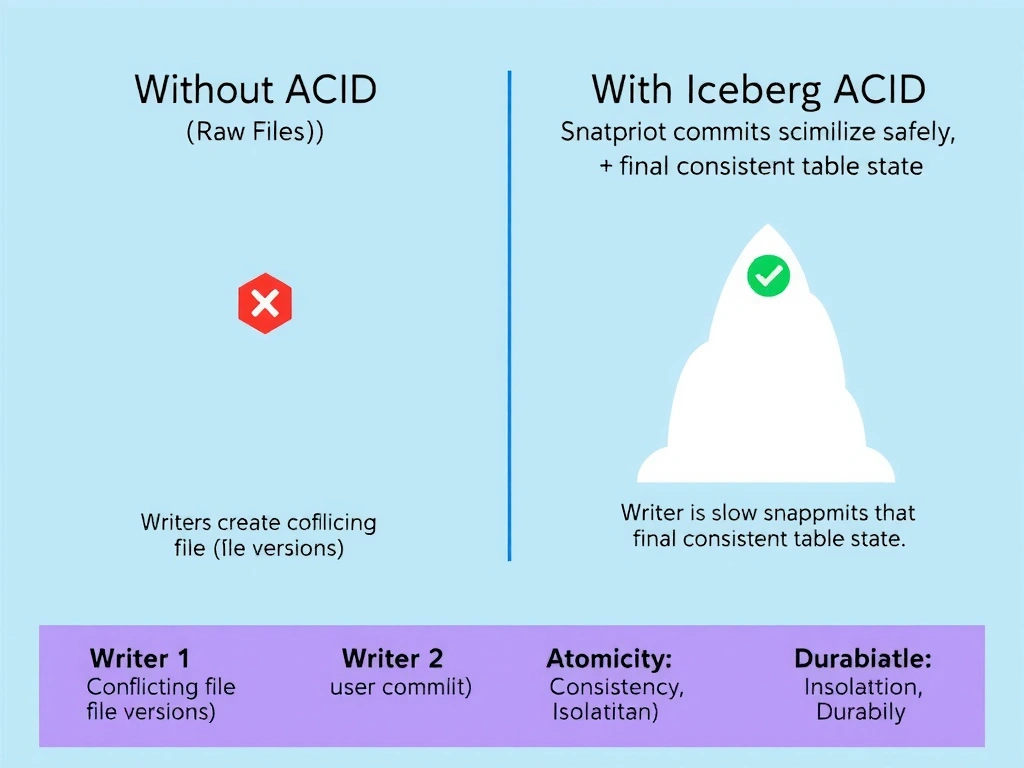
Here's the deal: ACID — Atomicity, Consistency, Isolation, Durability — is the backbone of any database system you'd trust with real transactions. In IBM watsonx.data, Apache Iceberg provides ACID guarantees on top of object storage, which historically offered none of that. Think of it this way: without ACID, two writers hitting the same table is like two people editing the same Google Doc offline — conflict guaranteed.
Full explanation below image
Full Explanation
IBM watsonx.data uses Apache Iceberg as its primary open table format, which delivers ACID transaction guarantees, schema evolution, and reliable concurrent access on top of object storage. This means multiple query engines can safely read and write to the same table without corrupting data or producing inconsistent results. Depending on file naming conventions for transactions (Option A) produces no real atomicity — if a write fails midway, there is no rollback, leaving the table in a partially updated state. Disabling metadata tracking to reduce overhead (Option C) removes the very mechanism that Iceberg uses to track snapshots, enforce consistency, and enable time travel — the platform cannot function correctly without it. Allowing each query engine to rewrite files independently (Option D) will cause write conflicts, data loss, and corrupted table states when multiple engines operate concurrently. Iceberg's snapshot-based commit protocol and optimistic concurrency control are precisely why it was selected as the preferred table format in watsonx.data.