
A senior engineer reviews the current plan and notices that one key control is missing. What is the best way to handle predictive vs exploratory analytics while staying aligned with the certification objectives?
Select an answer to reveal the explanation.
Short Explanation and Infographic
Think of watsonx.data like a modern city: the roads (network/storage) move data, the traffic laws (governance) control access, the vehicles (query engines) do the actual work, and city hall (metadata catalog) keeps the map current. IBM designed all five layers to work together as a system. Candidates who focus on one layer in isolation — just storage, just SQL, just governance — miss the architectural principle IBM is actually testing.
Full explanation below image
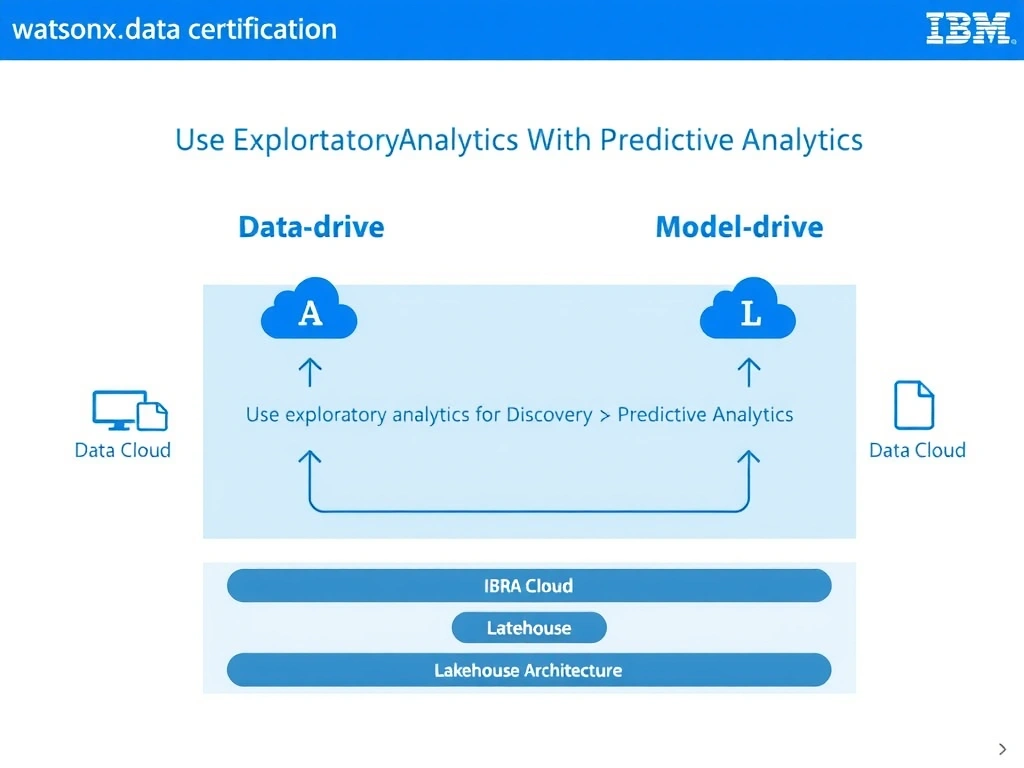
Full Explanation
The correct answer is option B: Use exploratory analytics for discovery and predictive analytics for model-driven forecasting or scoring.. This aligns with IBM's Data consumption and analytics guidance, which emphasizes use exploratory analytics for discovery and predictive analytics for model-driven forecasting or scoring as the recommended approach for production deployments. Option A (Treat ad hoc filtering as a trained predictive model) is incorrect because it either bypasses IBM's recommended architecture or introduces operational risk that the correct approach is specifically designed to avoid. Option C (Use predictive analytics when no target or history exists) is incorrect because it either bypasses IBM's recommended architecture or introduces operational risk that the correct approach is specifically designed to avoid. Option D (Avoid exploratory work before modeling) is incorrect because it either bypasses IBM's recommended architecture or introduces operational risk that the correct approach is specifically designed to avoid. Understanding this distinction is critical for the C9007300 exam: IBM watsonx.data is designed to enforce governance, performance, and operational best practices through its built-in architecture, and the correct answers consistently reflect those architectural constraints rather than shortcut alternatives.