
An administrator is troubleshooting a pilot deployment and wants the most appropriate next step. The team is focused on federated queries. Which recommendation is most appropriate?
Select an answer to reveal the explanation.
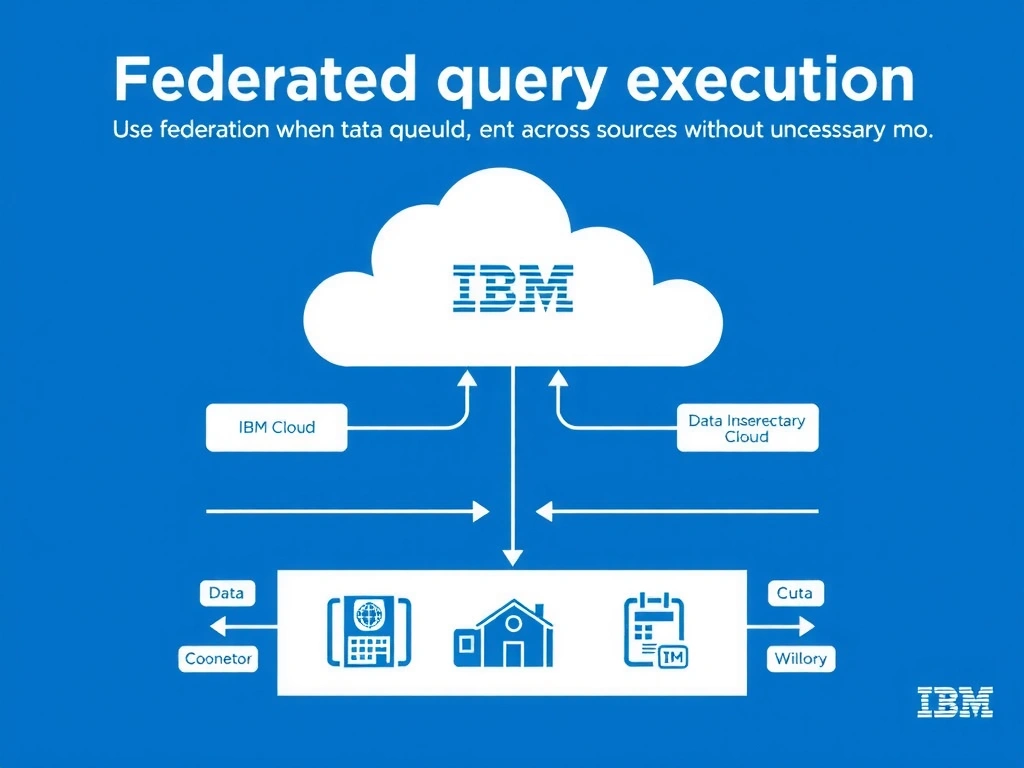
Short Explanation and Infographic
Here's the federation reality: watsonx.data's federation capability is one of the platform's highest-leverage features during enterprise adoption because most organizations have existing data in Db2, Oracle, Teradata, or cloud warehouses that they can't or won't migrate immediately. Federation lets you query that existing data through Presto alongside native lakehouse tables, enabling a gradual migration without a hard cutover. The exam tests this pattern because knowing when to federate versus ingest is a practical design decision every implementation architect faces.
Full explanation below image
Full Explanation
The correct answer is option C: Use federation when data should be queried across sources without unnecessary movement.. This aligns with IBM's Data integration patterns guidance, which emphasizes use federation when data should be queried across sources without unnecessary movement as the recommended approach for production deployments. Option A (Federate only after duplicating every source locally) is incorrect because it either bypasses IBM's recommended architecture or introduces operational risk that the correct approach is specifically designed to avoid. Option B (Use federation to avoid all access controls) is incorrect because it either bypasses IBM's recommended architecture or introduces operational risk that the correct approach is specifically designed to avoid. Option D (Assume federation makes slow remote sources local) is incorrect because it either bypasses IBM's recommended architecture or introduces operational risk that the correct approach is specifically designed to avoid. Understanding this distinction is critical for the C9007300 exam: IBM watsonx.data is designed to enforce governance, performance, and operational best practices through its built-in architecture, and the correct answers consistently reflect those architectural constraints rather than shortcut alternatives.