
An administrator is troubleshooting a pilot deployment and wants the most appropriate next step. Which approach best demonstrates deployment options in a IBM Certified watsonx Data Lakehouse Engineer environment?
Select an answer to reveal the explanation.
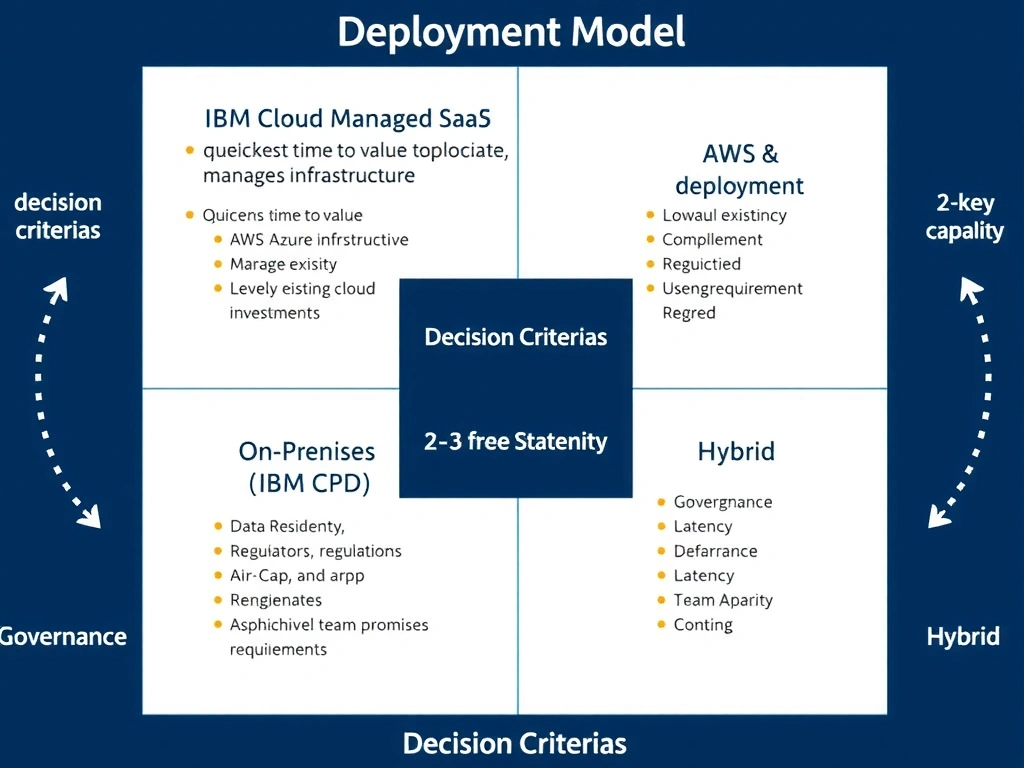
Short Explanation and Infographic
Think of watsonx.data like a modern city: the roads (network/storage) move data, the traffic laws (governance) control access, the vehicles (query engines) do the actual work, and city hall (metadata catalog) keeps the map current. IBM designed all five layers to work together as a system. Candidates who focus on one layer in isolation — just storage, just SQL, just governance — miss the architectural principle IBM is actually testing.
Full explanation below image
Full Explanation
The correct answer is option C: Match deployment choices to hybrid-cloud, governance, and operational requirements.. This aligns with IBM's IBM watsonx.data platform architecture guidance, which emphasizes match deployment choices to hybrid-cloud, governance, and operational requirements as the recommended approach for production deployments. Option A (Assume all deployments must be single-node local installs) is incorrect because it either bypasses IBM's recommended architecture or introduces operational risk that the correct approach is specifically designed to avoid. Option B (Ignore network and identity integration planning) is incorrect because it either bypasses IBM's recommended architecture or introduces operational risk that the correct approach is specifically designed to avoid. Option D (Choose deployment based only on dashboard color) is incorrect because it either bypasses IBM's recommended architecture or introduces operational risk that the correct approach is specifically designed to avoid. Understanding this distinction is critical for the C9007300 exam: IBM watsonx.data is designed to enforce governance, performance, and operational best practices through its built-in architecture, and the correct answers consistently reflect those architectural constraints rather than shortcut alternatives.