
A senior developer who had sole access to the production watsonx Assistant API key has unexpectedly left the organization. The security team needs to immediately prevent this individual from accessing the assistant. What is the MOST appropriate action?
Select an answer to reveal the explanation.
Short Explanation and Infographic
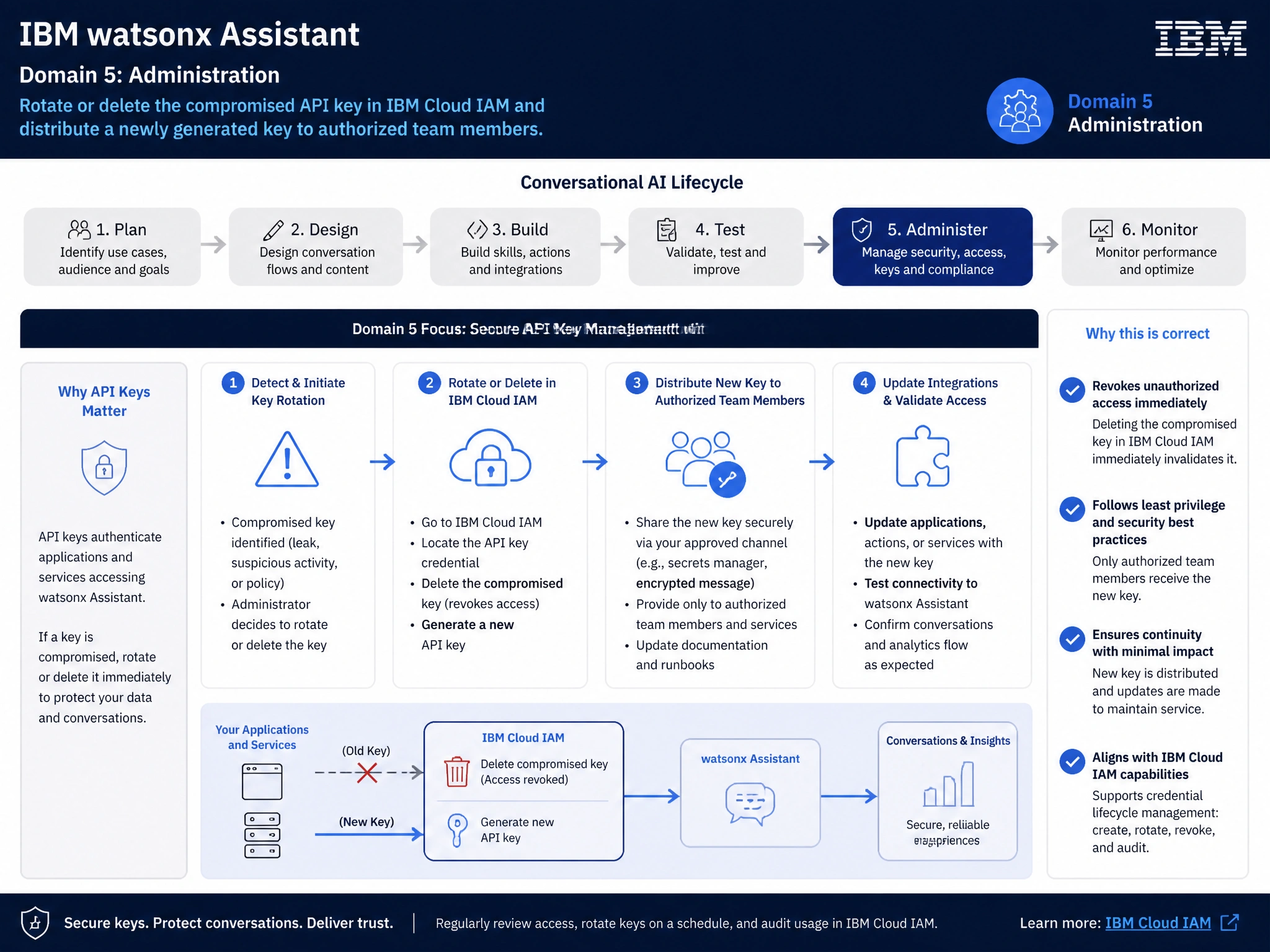
Todd Lammle: 'Imagine you're building a chatbot and this exact situation comes up — rotate or delete the compromised api key in ibm cloud iam and distribute a newly generated key to authorized team members is your go-to move. Rotating or revoking the API key through IBM Cloud IAM immediately terminates access for the departed employee without disrupting service availability. This is a classic Domain 5: Administration concept you'll want locked in before exam day.'
Full explanation below image
Full Explanation
Rotating or revoking the API key through IBM Cloud IAM immediately terminates access for the departed employee without disrupting service availability. A new key is then generated and securely shared only with authorized personnel. Deleting the instance would cause unnecessary downtime and data loss, while dialog-level blocks are not a valid security boundary. The correct answer, "Rotate or delete the compromised API key in IBM Cloud IAM and distribute a newly generated key to authorized team members", directly satisfies the scenario because it aligns with watsonx Assistant's design principles and the specific capability being tested. The incorrect options ("Delete the watsonx Assistant service instance entirely and recreate it from a backup", "Update all dialog nodes to reject inputs from the former employee's known device", "Temporarily suspend the assistant until a full security audit is complete") may appear relevant but each misses a key requirement or introduces a step that is either unnecessary or belongs to a different workflow. Mastering the distinction between these approaches is essential for effective watsonx Assistant implementations and is a core focus of the Domain 5: Administration section of the certification exam.