
A design team is preparing documentation for a watsonx Assistant deployment at a B2B software company. The assistant will handle customer technical support inquiries. The team needs an artifact that clearly defines what the assistant will handle and what it will not. Which artifact is MOST effective?
Select an answer to reveal the explanation.
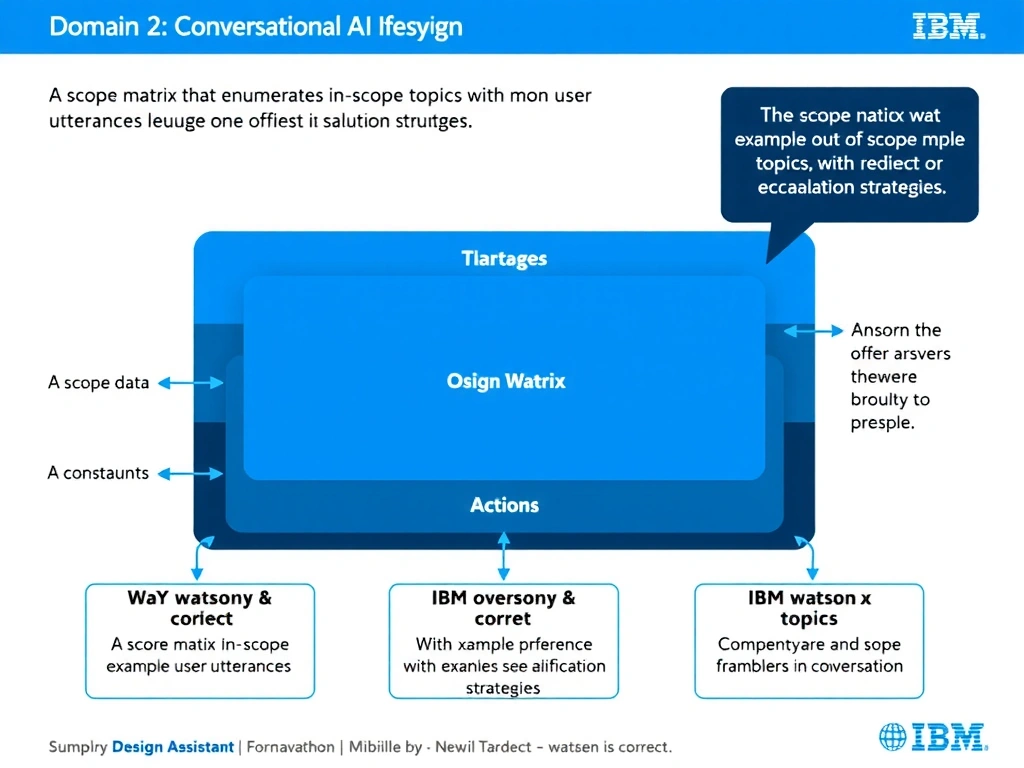
Short Explanation and Infographic
Todd Lammle: 'Imagine you're building a chatbot and this exact situation comes up — a scope matrix that enumerates in-scope topics with example user utterances alongside out-of-scope topics with defined redirect or escalation strategies is your go-to move. A scope matrix is the primary artifact for documenting conversational scope. This is a classic Domain 2: Conversational AI Design concept you'll want locked in before exam day.'
Full explanation below image
Full Explanation
A scope matrix is the primary artifact for documenting conversational scope. It serves as a shared contract among business stakeholders, designers, and developers by explicitly listing what the assistant handles with example utterances and what it does not with defined fallback and escalation strategies. Architecture diagrams address technical connectivity. Marketing materials and user manuals serve entirely different audiences and do not define conversational behavior boundaries. The correct answer, "A scope matrix that enumerates in-scope topics with example user utterances alongside out-of-scope topics with defined redirect or escalation strategies", directly satisfies the scenario because it aligns with watsonx Assistant's design principles and the specific capability being tested. The incorrect options ("A technical architecture diagram illustrating how the assistant integrates with the CRM, ticketing system, and knowledge base", "A marketing one-pager that highlights the assistant's top three capabilities for the company website", "A user manual explaining how customers should operate the software product being supported") may appear relevant but each misses a key requirement or introduces a step that is either unnecessary or belongs to a different workflow. Mastering the distinction between these approaches is essential for effective watsonx Assistant implementations and is a core focus of the Domain 2: Conversational AI Design section of the certification exam.