
What is the primary purpose of implementing an automated 'pipeline' in an enterprise MLOps workflow?
Select an answer to reveal the explanation.
Short Explanation
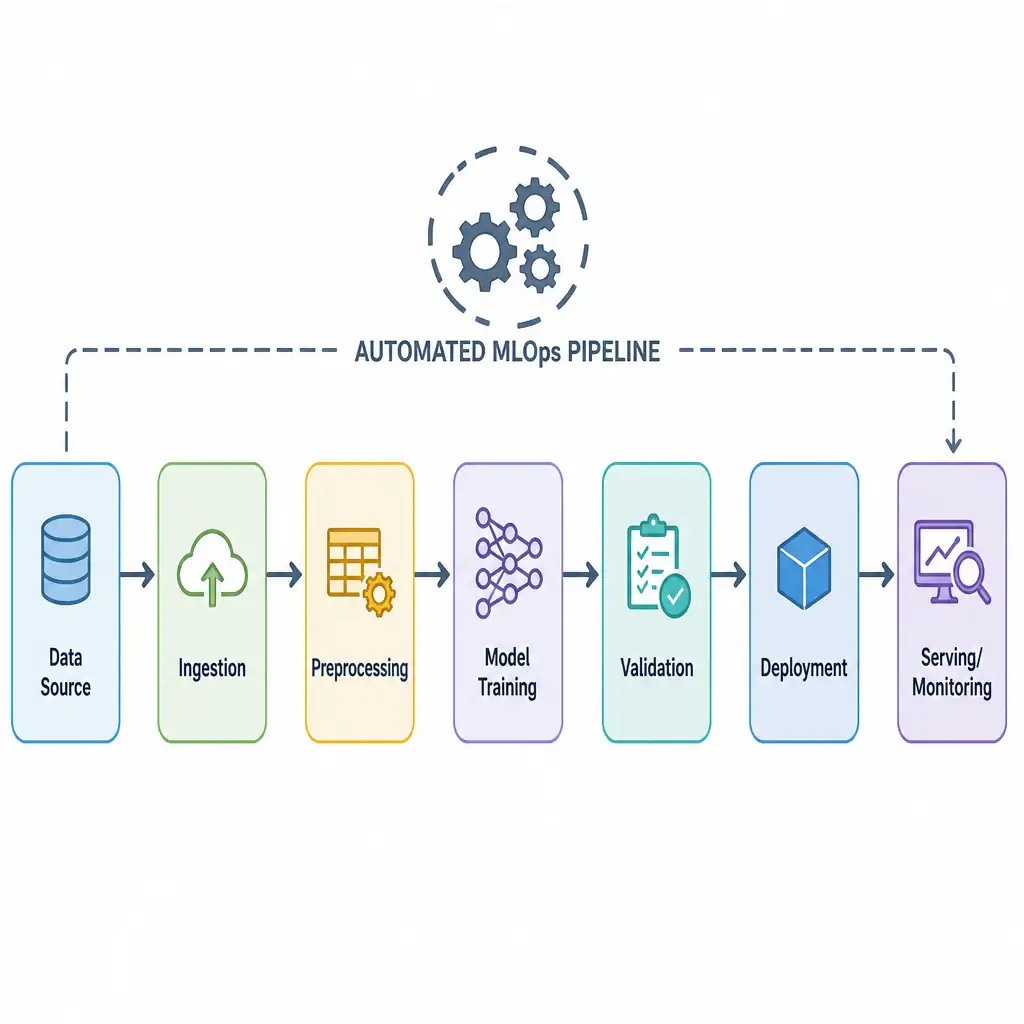
If you tried to clean, train, test, and deploy by hand every time new data showed up, you'd be buried in repetitive work and mistakes. An automated pipeline connects those steps into one repeatable flow, so new data can trigger training, validation, and deployment without you babysitting each stage. That's what turns scattered scripts into real MLOps.
Full Explanation
In Machine Learning Operations (MLOps), a pipeline is a conceptual and technical framework designed to automate and orchestrate the end-to-end machine learning workflow. A typical ML lifecycle involves multiple sequential steps: data ingestion, data cleaning, feature engineering, model training, hyperparameter tuning, model evaluation, and deployment. Without a pipeline, these steps are executed manually by different teams, such as data engineers, data scientists, and DevOps engineers, using disjointed scripts, which is slow, prone to human error, and difficult to reproduce. An MLOps pipeline automates these steps, treating them as a continuous, unified system. The output of one step automatically triggers the input of the next. For example, if a data validation step passes, the pipeline automatically starts the training step. Pipelines ensure repeatability, so that the model can be retrained on new data exactly the same way; auditability, by tracking how a specific model was produced; and speed, by reducing time-to-market. The incorrect choice that describes enforcing manual execution of each step of model building is wrong because pipelines are specifically designed to eliminate manual execution and human intervention, not enforce it. The incorrect choice that describes providing a version control repository specifically for tracking manual modifications to database schemas is wrong because that describes database version control or schema migration tracking, which is a software engineering task unrelated to the orchestration of ML lifecycles. The incorrect choice that describes running manual testing on frontend user interfaces where the model's predictions will be displayed is wrong because that describes frontend testing, such as UI testing, which is part of web development quality assurance and is distinct from the automated training and serving of ML models. Therefore, the primary purpose of an MLOps pipeline is to automate and orchestrate the entire machine learning lifecycle, connecting data collection, training, testing, and deployment into a repeatable flow.