
Within a modern enterprise MLOps (Machine Learning Operations) pipeline, what does the term 'Continuous Delivery (CD)' specifically refer to?
Select an answer to reveal the explanation.
Short Explanation
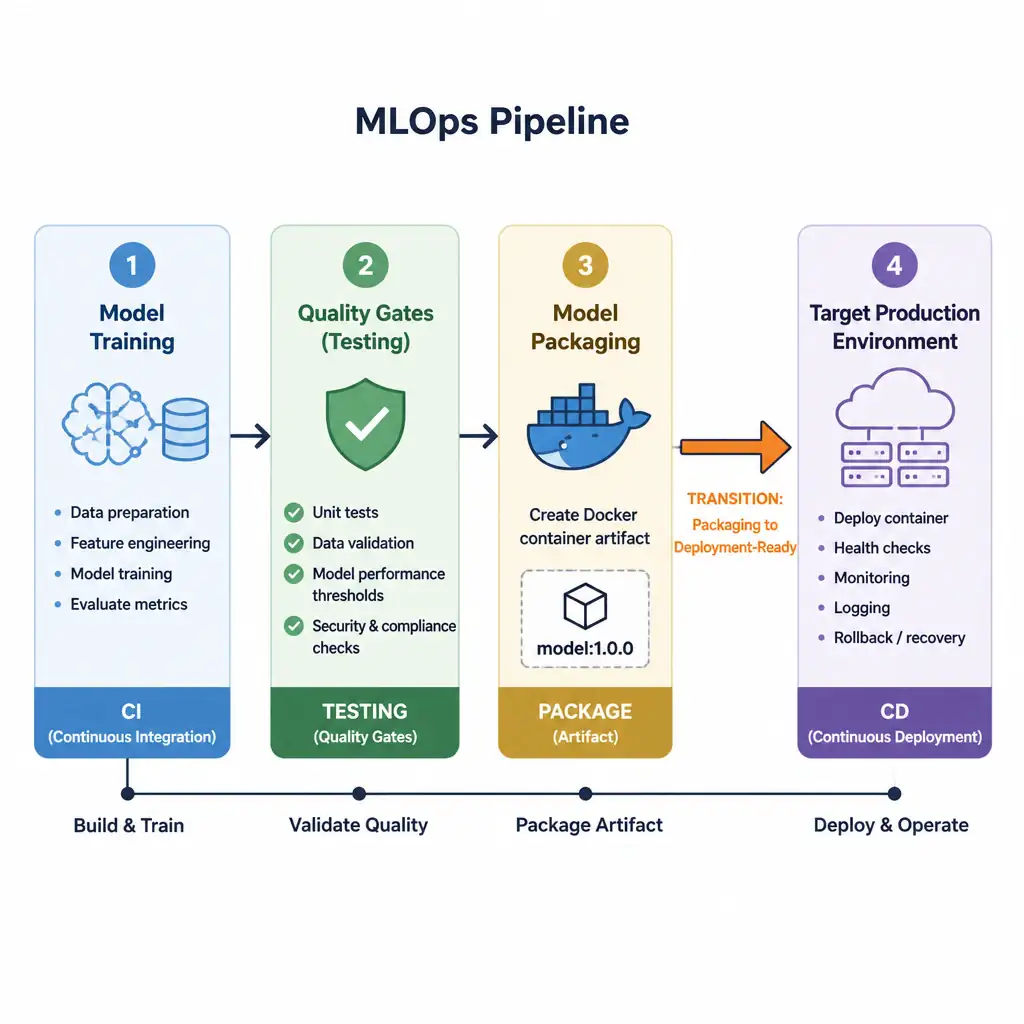
Continuous Delivery in MLOps is the automated pipeline that builds, tests, and packages a validated model so it's ready to ship. You're not retraining it by hand, watching it in production, or cleaning raw data—you're getting a proven model packaged for deployment.
Full Explanation
In Machine Learning Operations, Continuous Delivery is the phase of the pipeline that automates the deployment preparation of machine learning models. Once a model is trained through Continuous Integration and passes quality gates such as accuracy, fairness, and latency checks, the Continuous Delivery pipeline takes over. It packages the model, along with its inference code and dependency files, into a deployable artifact such as a Docker container image. That container is then automatically pushed to a registry and prepared for release to a staging or production environment. The goal of Continuous Delivery is to ensure that the model can be deployed reliably and repeatedly at any time with minimal manual intervention. The monitoring description is incorrect because it describes post-deployment monitoring, which tracks the health, prediction latency, and input or output drift of a model while it serves live traffic. The manual retraining description is incorrect because manual retraining on local workstations using newly collected datasets is the opposite of an automated MLOps pipeline and introduces human error and deployment bottlenecks. The ingestion and preprocessing description is incorrect because it describes the beginning of the machine learning pipeline, where raw data is cleaned and prepared before training or delivery begins. Therefore, the automated process of building, testing, packaging, and preparing a validated machine learning model for production is the correct definition of Continuous Delivery.