
How do Feedforward Neural Networks (FNNs) and Recurrent Neural Networks (RNNs) differ in their architectural design and data processing capabilities?
Select an answer to reveal the explanation.
Short Explanation
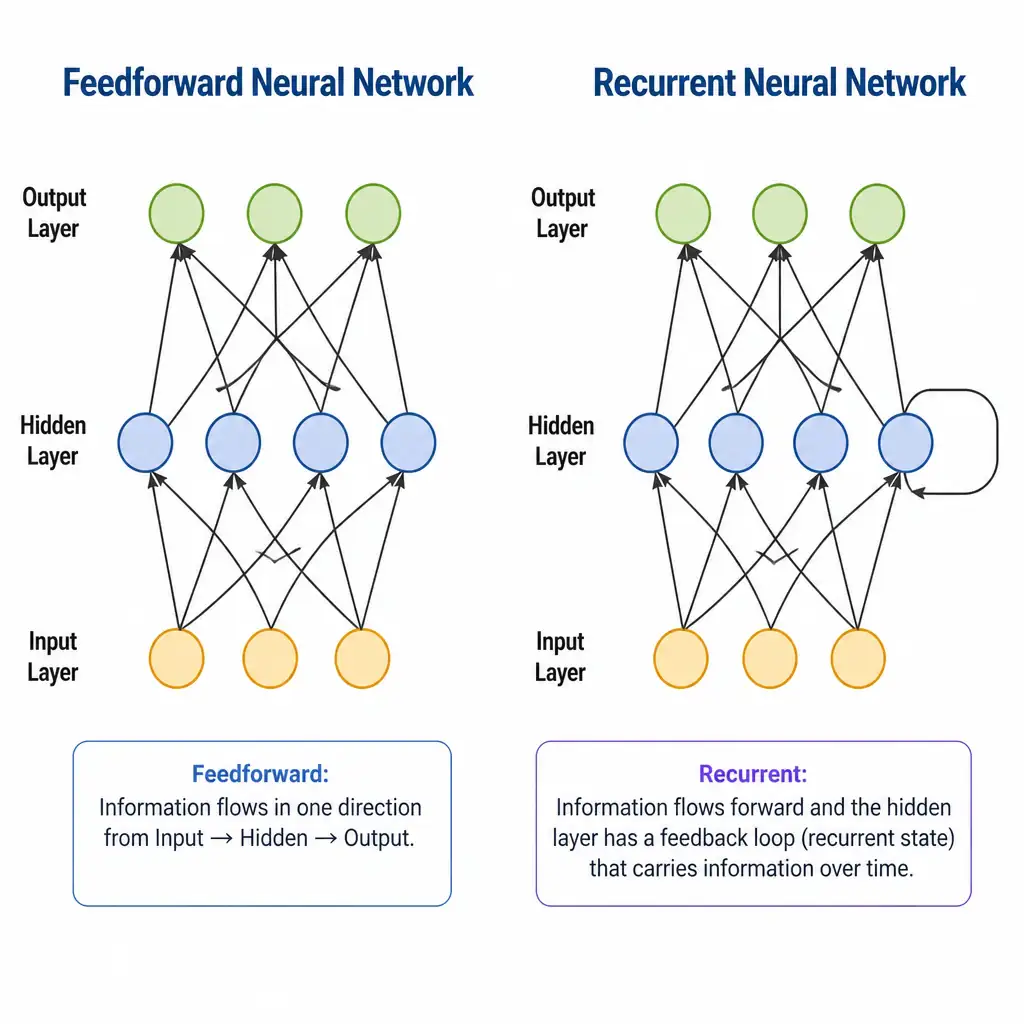
Think of a feedforward network as a one-way street: data moves straight through, and it's done; there's no memory of what just happened. A recurrent network has loops that keep a running state, so you can feed it sequences of different lengths. Remember this contrast for the exam: one-way with no memory versus loops for sequences over time.
Full Explanation
The structural and functional differences between feedforward neural networks and recurrent neural networks lie in how information flows through the network architecture. In a feedforward neural network, connections between nodes do not form cycles or loops. Information moves strictly in one direction, from the input layer, through any hidden layers, to the output layer. Feedforward networks assume that inputs are independent of one another and require a fixed-size input vector, such as a fixed grid of pixels in an image. Because they lack temporal memory, they are not naturally suited for tasks where context over time is important. In contrast, a recurrent neural network contains cyclic connections or feedback loops. At each step in a sequence, the recurrent network takes the current input vector and combines it with the hidden state, meaning the activation values from the previous time step. This feedback loop allows the network to pass information across time steps, maintaining an internal memory or state of the historical sequence. Consequently, recurrent networks can process variable-length sequential inputs, such as natural language text, audio waveforms, or time-series data, and capture temporal dependencies where the order of inputs matters. The claim that feedforward networks require backpropagation to update weights during training, while recurrent networks use recurrent connections to bypass the backpropagation phase entirely, is incorrect because both architectures use backpropagation, with recurrent networks using Backpropagation Through Time to update weights across time steps. The claim that feedforward networks are restricted to unsupervised clustering tasks, while recurrent networks are utilized exclusively for supervised linear regression problems, is incorrect because both are primarily supervised learning architectures that can perform both classification and regression. The claim that feedforward networks process variable-length inputs by dynamically adding hidden layers, while recurrent networks are constrained to fixed-size input vectors because they lack hidden states, is incorrect because it reverses the input constraints and dynamic capabilities of the two networks. Therefore, the key differentiator is that feedforward networks have a unidirectional flow with no memory, whereas recurrent networks have feedback loops to process sequences.