
A healthcare tech startup is developing a deep learning model to identify lung nodules in chest X-rays. During the data collection and ingestion phase, what is the primary ethical and regulatory constraint they must enforce regarding patient data privacy?
Select an answer to reveal the explanation.
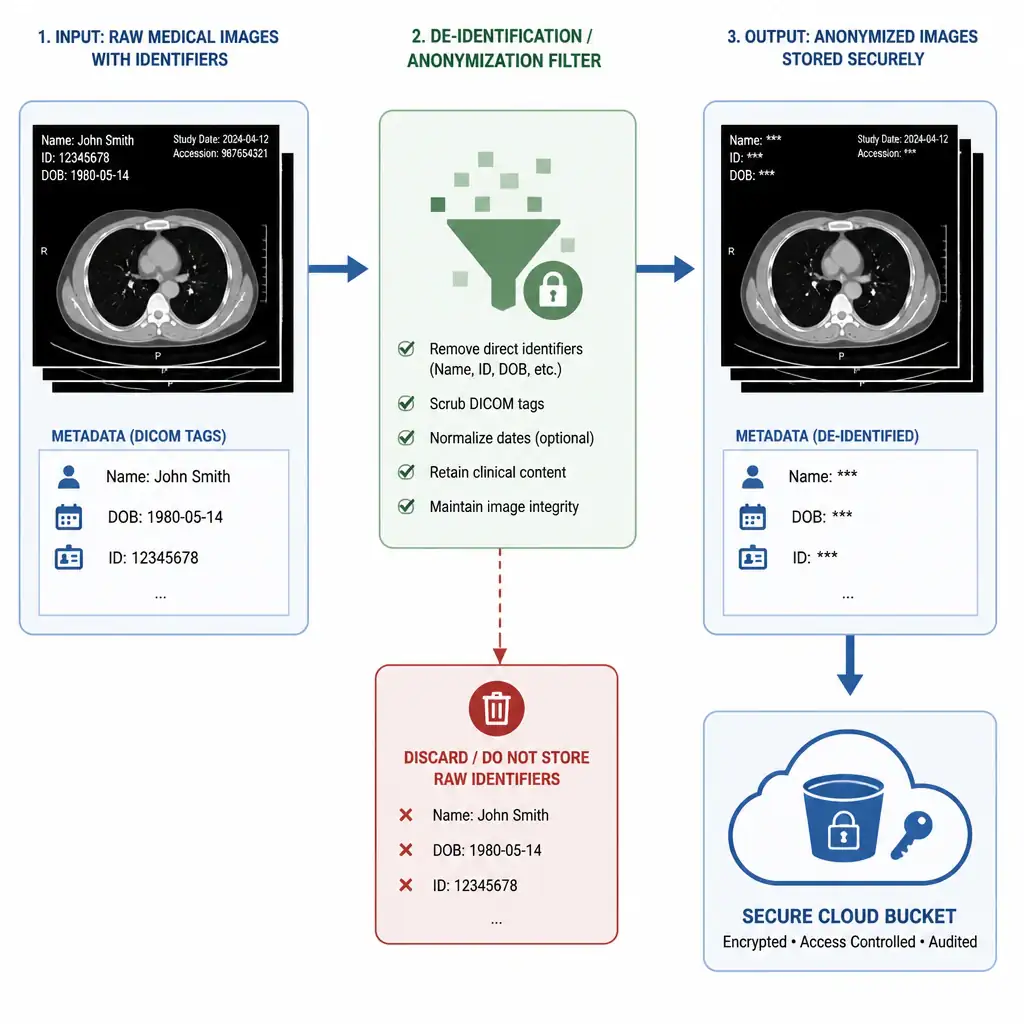
Short Explanation
Here's the deal: when you're handling chest X-rays, you're handling real patient privacy, not just pixels. You've got to strip out identifiers and keep the data encrypted in secure, compliance-controlled environments. Ignore that, and you're begging for fines, lawsuits, and harm to patients.
Full Explanation
When developing machine learning models for healthcare and clinical environments, compliance with data privacy regulations such as HIPAA in the United States and GDPR in Europe is a primary ethical and legal requirement. Medical imaging data, such as chest X-rays, MRI scans, and CT scans, contains Protected Health Information within both the images themselves and the associated metadata, including DICOM headers. To protect patient confidentiality, developers must perform robust de-identification and anonymization. This process involves stripping out direct identifiers such as names, medical record numbers, dates of birth, and geographic locations. Additionally, the data must be processed and stored securely, with role-based access control, auditing mechanisms, and encryption both at rest and in transit to prevent unauthorized access and data breaches. The de-identification and anonymization approach, combined with encrypted storage in secure, compliance-controlled environments, is therefore the correct privacy constraint. The public web page option is incorrect because hosting a medical model on a public web page without security controls or registration would expose sensitive systems and fail to protect user upload privacy. The small single-hospital option is incorrect because training models on small, single-center datasets typically leads to overfitting and poor generalization due to selection bias, which is itself an ethical issue in medical AI rather than a privacy compliance strategy. The encrypt-only-weights option is incorrect because encrypting only the final model weights is insufficient; the raw training data represents the primary privacy risk and must be fully secured throughout the entire lifecycle. Therefore, anonymizing patient data and implementing secure, compliant processing environments is the critical privacy constraint.