During the lifecycle of an enterprise machine learning system, which statement describes the primary objective of the model deployment phase?
Select an answer to reveal the explanation.
Short Explanation and Infographic
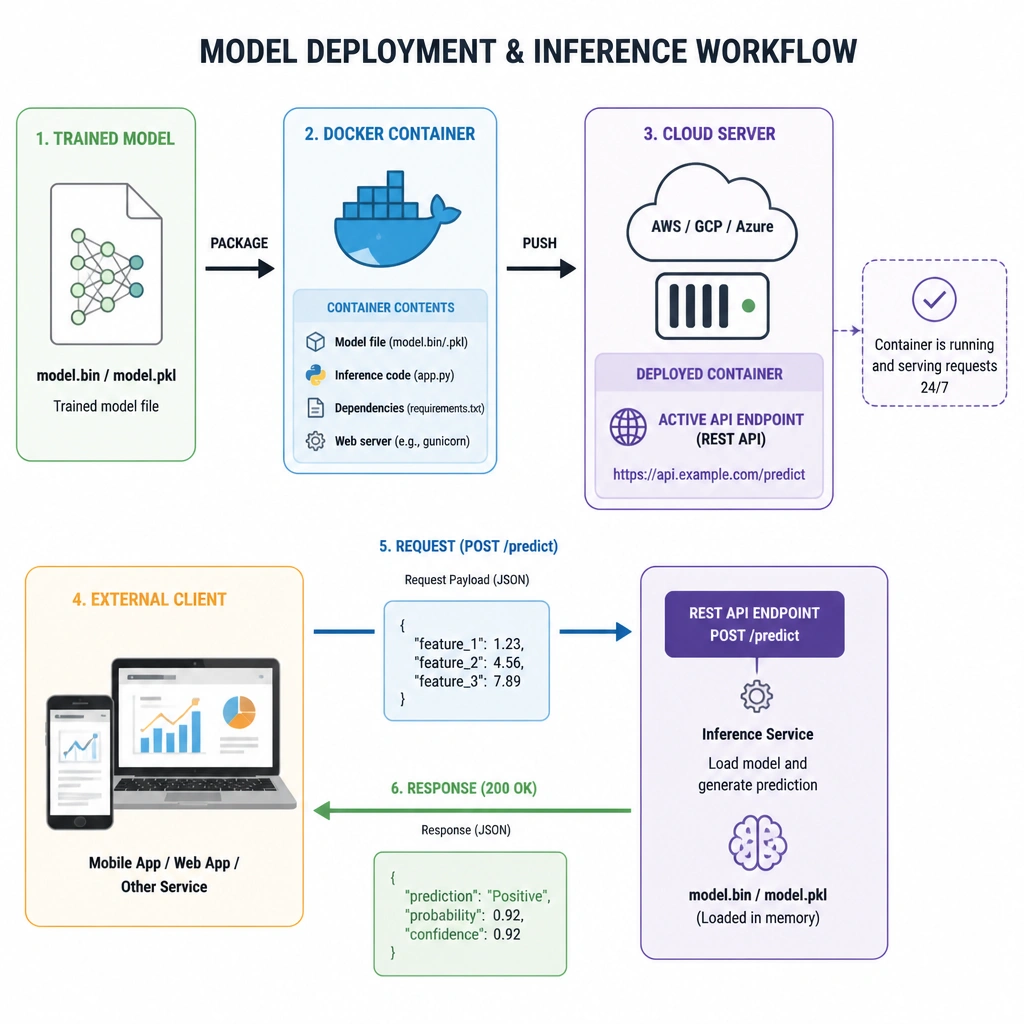
Here's the deal: you've gathered your data, cleaned it up, trained a killer model, and it's working beautifully on your laptop. But a model sitting on your laptop makes the company zero dollars! If your customers or web apps can't access it, it's useless. That's why we have the deployment phase. Think of deployment like launching a new product. You're taking that model, packing it up (usually in a container like Docker), and pushing it to a server or cloud service where it can listen for incoming requests. Now, when a customer clicks a button on your website, the site can send data to your model, and the model returns a prediction in real-time. We aren't training the model or cleaning data here—those steps are already done. Deployment is all about making your model live and accessible to the world. Got it? Sweet!
Full explanation below image
Full Explanation
The machine learning lifecycle consists of several sequential phases: data ingestion, data preprocessing, model training, model evaluation, and deployment. Once a model has been trained and rigorously evaluated to ensure it meets both accuracy and business requirements, it enters the deployment phase. The primary objective of deployment is to move the model from a local development or staging environment into a production environment where it can serve real-world predictions. This involves packaging the model artifact along with its dependencies (e.g., containerizing it using Docker) and hosting it on a scalable infrastructure (such as Kubernetes or serverless cloud functions). Once deployed, the model is exposed via an endpoint, typically a REST or gRPC API. This allows other software systems, such as mobile applications, web frontends, or batch processing pipelines, to send input features to the model and receive predictions in return. Deployment strategies can range from real-time web services that process individual requests with low latency, to batch inference pipelines that run periodically on large volumes of data. Let's look at why other options are incorrect: preparing the data (cleaning and feature engineering) occurs during the preprocessing phase; collecting data is the initial ingestion phase; training the model is the optimization phase where parameters are learned. Therefore, the deployment phase is specifically focused on operationalizing the model to deliver predictions to end users and applications.