During the training phase of a deep neural network, what is the specific role of the batch size hyperparameter?
Select an answer to reveal the explanation.
Short Explanation and Infographic
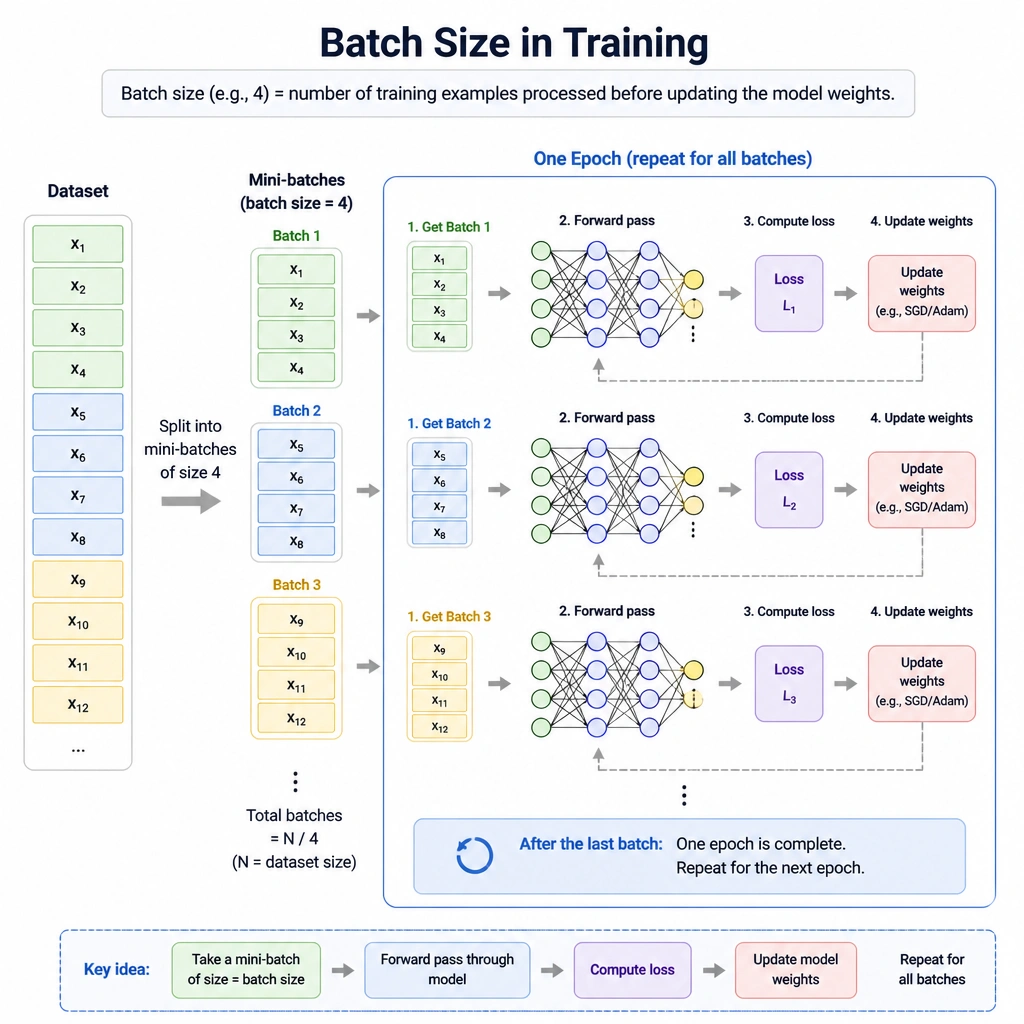
Okay, let's dive in. Imagine you're trying to learn a massive textbook with a million questions. If you read only one question, update your notes, and repeat that a million times, you'll be studying forever. But if you try to read all million questions at once before taking notes, your brain will melt. That's exactly why we use batch size. It's the sweet spot in the middle. The batch size is the number of training examples the neural network looks at in a single iteration before it updates its weights. Think of it like taking a small stack of flashcards, studying them, adjusting what you know, and then grabbing the next stack. Don't mix this up with an epoch, which is a full pass through the entire textbook, or the learning rate, which is how big of a step you take when you adjust your notes. Batch size is all about how many examples you process in a single update step. Got it? Sweet.
Full explanation below image
Full Explanation
In deep learning, training a neural network involves optimizing its weights using gradient descent. Due to computational and memory constraints, we rarely compute the gradient over the entire dataset at once (which is Batch Gradient Descent) or update the weights after every single sample (which is Stochastic Gradient Descent). Instead, we use Mini-batch Gradient Descent, controlled by the 'batch size' hyperparameter. The batch size specifies the number of training examples used in a single forward and backward pass to estimate the loss gradient and update the network's weights. For instance, if a dataset has 10,000 samples and the batch size is set to 100, the model will split the data into 100 batches, requiring 100 iterations (weight updates) to complete one full epoch. Choosing the correct batch size is a critical design decision. Smaller batch sizes introduce more noise into the gradient estimation, which can act as a regularizer and help the model escape local minima, but they may slow down training because they underutilize GPU parallelization. Larger batch sizes speed up computation by leveraging hardware parallel processing, but they require more GPU memory and can lead to generalization issues if the model converges to sharp minima. Let's clarify the incorrect options: the number of layers determines the depth of the network; the number of epochs is the count of complete passes through the entire dataset; the learning rate is a scaling factor that controls the step size of weight updates. Therefore, the batch size specifically defines the number of samples processed per weight update iteration.