In natural language processing (NLP), what is the primary purpose of utilizing pre-trained word representation models such as Word2Vec or GloVe?
Select an answer to reveal the explanation.
Short Explanation and Infographic
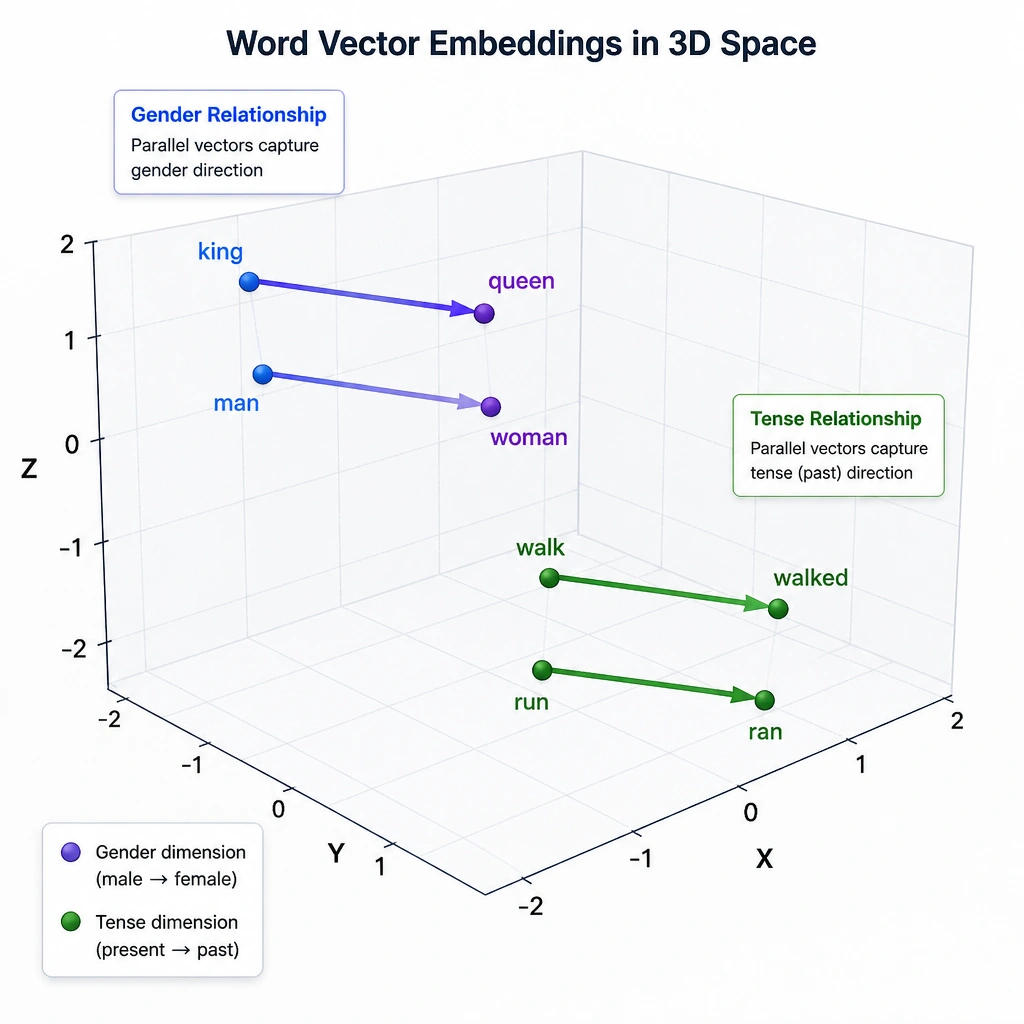
Check this out: computers are numbers guys—they don't know what a 'king' or a 'queen' is. If you just give them a list of words, they're lost. In the early days, we used one-hot encoding, which represented every word as a giant, empty list of zeros with a single '1' in it. Not very efficient! That's where word embeddings like Word2Vec and GloVe come into play. Think of them like a multi-dimensional map of language. They convert words into dense numbers—vectors—that group similar words close together. Because of this, the model learns that 'king' and 'queen' have a similar relationship to 'man' and 'woman.' It's like teaching a machine to understand context and meaning, not just letters. Paying close attention here: embeddings are the foundation of modern NLP, so make sure you understand how they capture semantic relationships! Sweet, let's keep rolling.
Full explanation below image
Full Explanation
In natural language processing, representing words mathematically is a crucial step before feeding text data into machine learning algorithms. Word embeddings, such as Word2Vec (developed by Google) and GloVe (Global Vectors for Word Representation, developed by Stanford), are techniques designed to represent words in a dense vector space. Unlike traditional representation techniques like Bag-of-Words or TF-IDF, which produce high-dimensional, sparse vectors representing simple word frequencies, word embeddings map vocabulary words to dense, low-dimensional vectors (typically containing 100 to 300 dimensions). The defining characteristic of these embeddings is their ability to capture semantic and syntactic relationships. The vector representations are learned from large corpora of text based on the distributional hypothesis, which states that words appearing in similar contexts tend to have similar meanings. In this dense space, the geometric distance and direction between word vectors reflect their semantic similarity. For instance, the vector operation 'king - man + woman' yields a vector very close to 'queen'. Let's review the incorrect options: Counting the frequency of words refers to basic bag-of-words models; representing words as sparse vectors is characteristic of one-hot encoding or TF-IDF, which do not capture semantic relationships and suffer from the curse of dimensionality; removing stop words is a distinct preprocessing step that strips out uninformative words. In conclusion, Word2Vec and GloVe are essential for creating dense vector representations that allow NLP models to understand semantic context and vocabulary relationships.