
When you are training a supervised machine learning model, the algorithm needs a way to calculate how well or how poorly its predictions match the actual target values. Which component performs this calculation by outputting a single numerical value representing the prediction error?
Select an answer to reveal the explanation.
Short Explanation
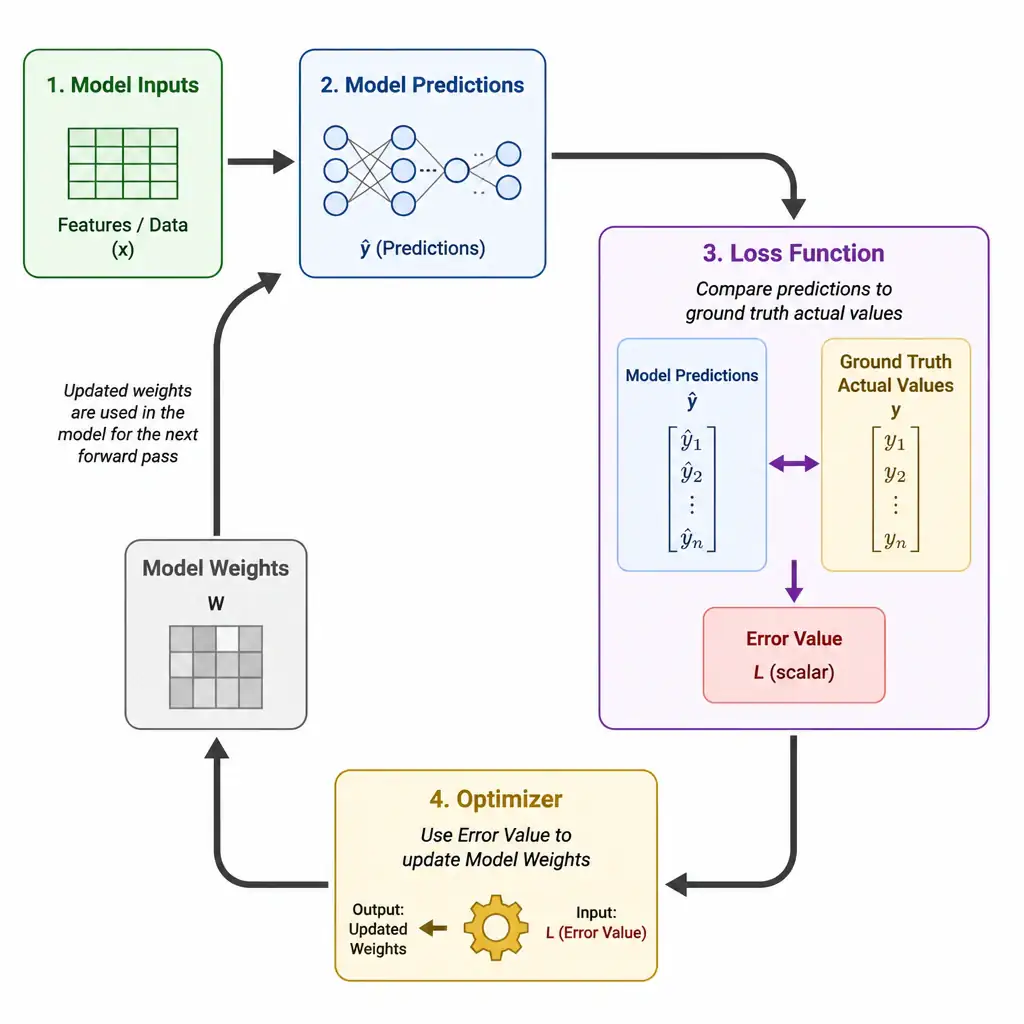
Think of it like archery: if you're off target, you need to know how far off you were. The loss function is the scorecard that compares your model's predictions to the actual answers and gives one number for the error. Training aims to push that number toward zero, while the optimizer uses that number to adjust the weights.
Full Explanation
The loss function, also known as a cost function or objective function, is a mathematical function that maps the decisions of a machine learning model to a real number representing the cost or error associated with those decisions. In supervised learning, the loss function takes two inputs: the model's predicted values (y-hat) and the actual target labels (y), and calculates the difference between them. Common examples include Mean Squared Error for regression tasks and Cross-Entropy Loss for classification tasks. The output of the loss function is used by optimization algorithms, such as Gradient Descent, to compute gradients, which are then used to update the model's weights and biases. Minimizing the loss value over the training dataset is the fundamental mechanism of model learning. The outlier detection filter is a preprocessing component used to remove anomalous data points, not a component that calculates prediction error during model training. The model complexity metric, such as parameter counts or structural indicators, measures the capacity of the model, not its prediction errors. The optimization algorithm, like Gradient Descent, is responsible for updating the weights of the model, often described in French as 'mettre à jour les poids du modèle'. While it uses the loss value to calculate how to update weights, it does not calculate the loss itself. Therefore, the component that outputs a single numerical value representing prediction error is the loss function.