
When training a deep convolutional neural network, a developer decides to use the Adam optimizer rather than basic Stochastic Gradient Descent (SGD). What is the primary operational advantage of the Adam optimizer over basic SGD?
Select an answer to reveal the explanation.
Short Explanation
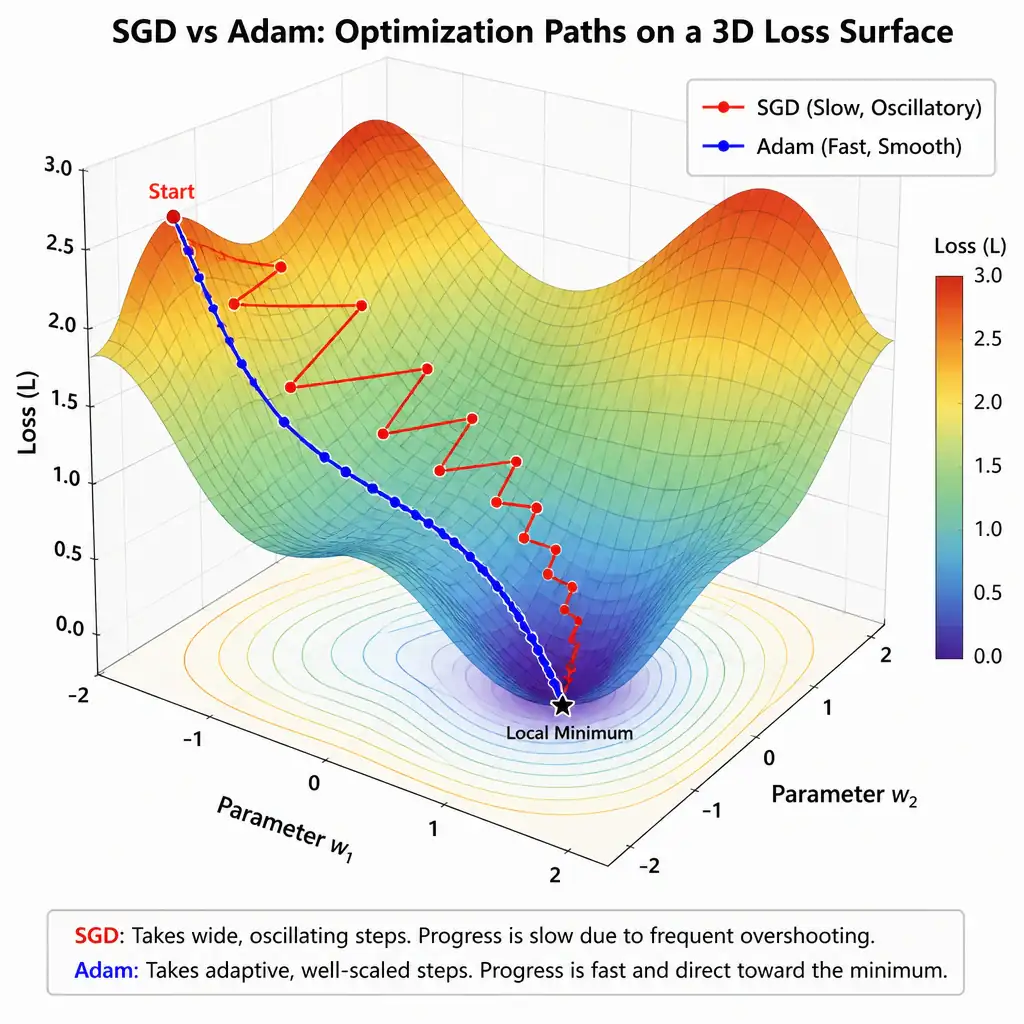
If you've ever trained a neural network, you know finding the right learning rate is a nightmare. Basic SGD uses one constant learning rate for everything, so it's slow and clumsy. Adam is a massive upgrade because it combines momentum with adaptive learning rates, scaling the step size for every parameter so training is faster and more stable.
Full Explanation
The Adam (Adaptive Moment Estimation) optimizer is widely preferred in deep learning because it addresses several limitations of basic Stochastic Gradient Descent (SGD). SGD applies a single, static learning rate to all parameters, which can lead to slow convergence or oscillation in ravines of the loss landscape.
The correct answer is the choice that says Adam combines the concepts of momentum and adaptive learning rates, calculating individual learning rates for each parameter. Adam calculates adaptive learning rates for each individual parameter by keeping track of exponentially decaying average past gradients (first moment, simulating momentum) and exponentially decaying average past squared gradients (second moment, simulating adaptive learning rates). This dual approach allows the optimizer to handle sparse gradients and non-stationary objectives efficiently.
The choice claiming a fixed, uniform learning rate for all network parameters is incorrect because Adam uses adaptive, parameter-specific learning rates rather than a fixed uniform learning rate.
The choice claiming guaranteed convergence to the global minimum of the loss function, regardless of initialization, is incorrect because, in non-convex optimization problems typical of deep learning, no standard gradient descent variant guarantees convergence to the global minimum.
The choice claiming a smaller memory footprint and fewer computations per epoch than basic SGD is incorrect because Adam requires more memory and computation per epoch than basic SGD, as it must maintain and update running averages of the first and second moments for every parameter.