A healthcare organization is integrating a deep learning model to assist radiologists in identifying pulmonary abnormalities in chest X-rays. When evaluating the ethical implications of this clinical AI tool, what is the primary ethical concern regarding its deployment?
Select an answer to reveal the explanation.
Short Explanation and Infographic
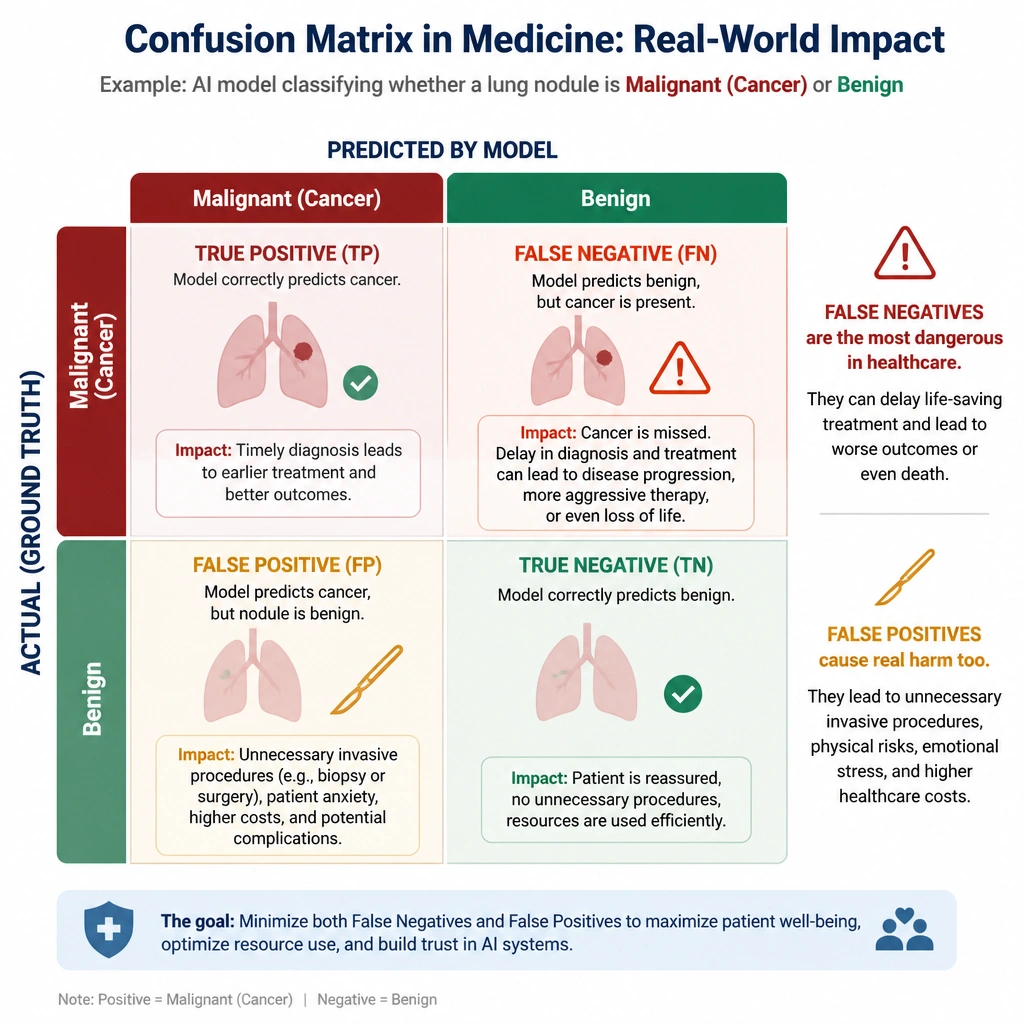
Here's the deal: when you're dealing with AI in medical imaging, we aren't just talking about a glitchy website recommending the wrong pair of shoes. We're talking about human lives. Imagine your system misreads a scan and flags a healthy patient with a severe illness—or worse, misses a tumor entirely. That's a false positive or false negative, and in the real world, that means unnecessary surgeries or delayed treatments. It's the ultimate trust exercise, and if your model gets it wrong, the consequences are devastating. Cost and speed are important to the business guys, sure, but safety and accuracy are the real ethical lines we can't cross. Trust me on this, when you write code for healthcare, the stakes couldn't be higher.
Full explanation below image
Full Explanation
The primary ethical concern associated with deploying AI systems in medical diagnostics centers on patient safety and the clinical consequences of model errors. Diagnostic models are susceptible to classification errors, which can directly cause patient harm. - Option C (The risk of diagnostic errors) is correct because false negatives (failing to detect a disease) can lead to a lack of treatment and disease progression, while false positives (incorrectly diagnosing a healthy patient) can lead to psychological trauma, unnecessary secondary tests, and invasive, risky medical interventions. - Option A (Operational cost) and Option B (Speed of the model) represent engineering and financial constraints, which are not core ethical issues threatening human life. - Option D (Structural simplicity) is a technical or theoretical concern regarding model representation capability, rather than an immediate ethical risk to patient outcomes.