A machine learning team deployed a model that recommends streaming content to users. A few weeks later, a major international sporting event begins, and the recommendations suddenly become highly irrelevant for a large portion of the user base. The engineering team analyzes the system and finds that the statistical distribution of the incoming user feature data has changed significantly, while the model's logic remains untouched. What specific issue does this represent?
Select an answer to reveal the explanation.
Short Explanation and Infographic
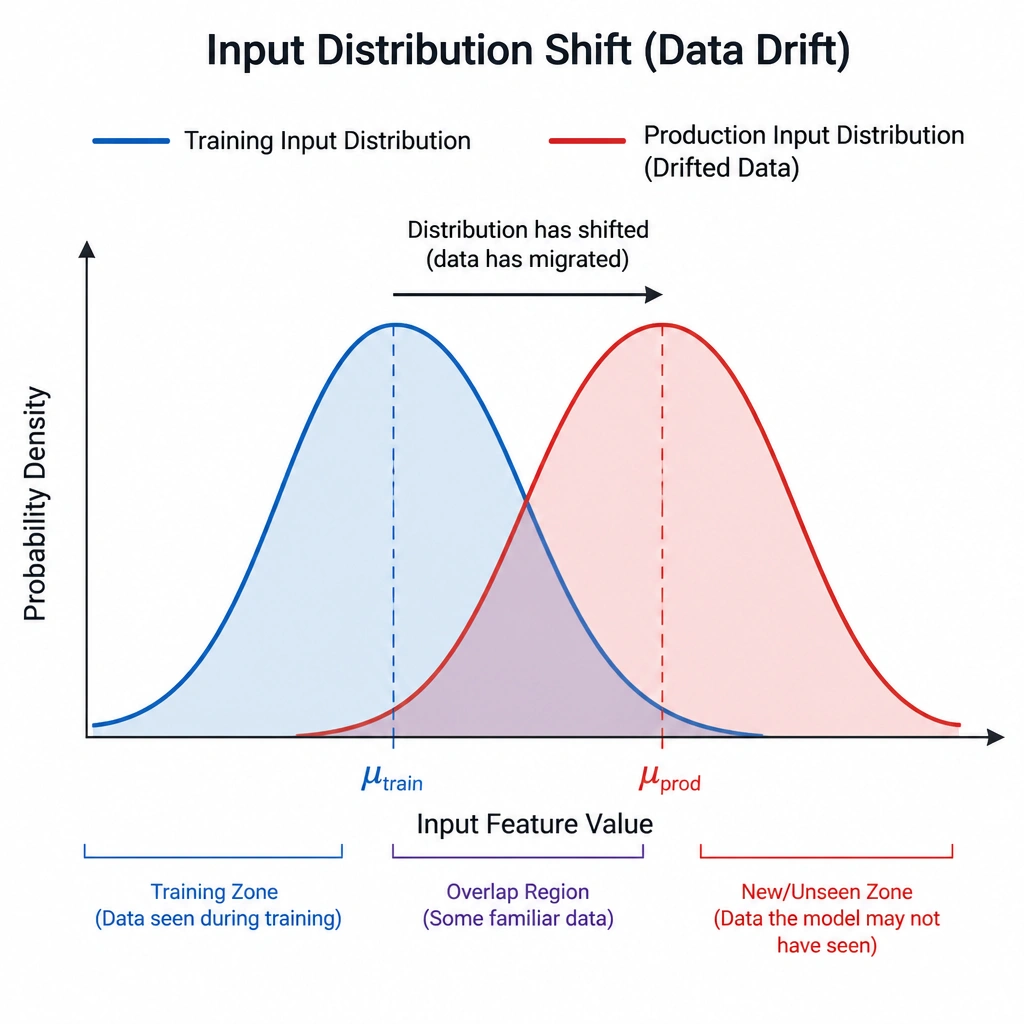
Alright, check this out. You deploy a killer recommendation engine to production, it's running like a champ, and then boom—a massive sporting event starts, everyone's behavior changes, and your model starts suggesting absolute garbage. What happened? Did the software crash? No, the data changed! The distribution of the inputs coming into your model shifted. We call this data drift. Think of it like tuning a radio to a crisp local station, and then driving into another state. The radio still works, but the signals hitting the antenna are totally different. You've got to watch out for this on live networks and systems, because if you don't monitor your input data, you'll be serving bad info and your boss is going to be breathing down your neck. Got it? Sweet. Let's keep rolling.
Full explanation below image
Full Explanation
Data drift, also known as covariate shift, occurs when the input data distribution changes over time while the underlying relationship between the input features and the target labels remains unchanged. In this scenario, the international sporting event shifted the demographics and behavior of active users, altering the feature space that the model was trained on, which led to a degradation in recommendation relevance. - Option B (Data drift) is correct because it describes the shift in the statistical distribution of the input variables. - Option A (Concept drift) is incorrect because concept drift refers to a change in the relationship between input features and target labels (i.e., what defines the target concept changes, such as what constitutes spam, even if the inputs look similar). - Option C (Model underfitting) is incorrect because underfitting is a training-phase problem where a model is too simple to capture the underlying patterns, not a production-time change in incoming data. - Option D (Overlearning) is incorrect because overlearning (overfitting) is a training-phase issue where a model memorizes the training data noise instead of generalizing, rather than a shift in production data distribution.