
Once a machine learning model is successfully deployed to production, what is the primary reason for establishing a continuous monitoring system?
Select an answer to reveal the explanation.
Short Explanation
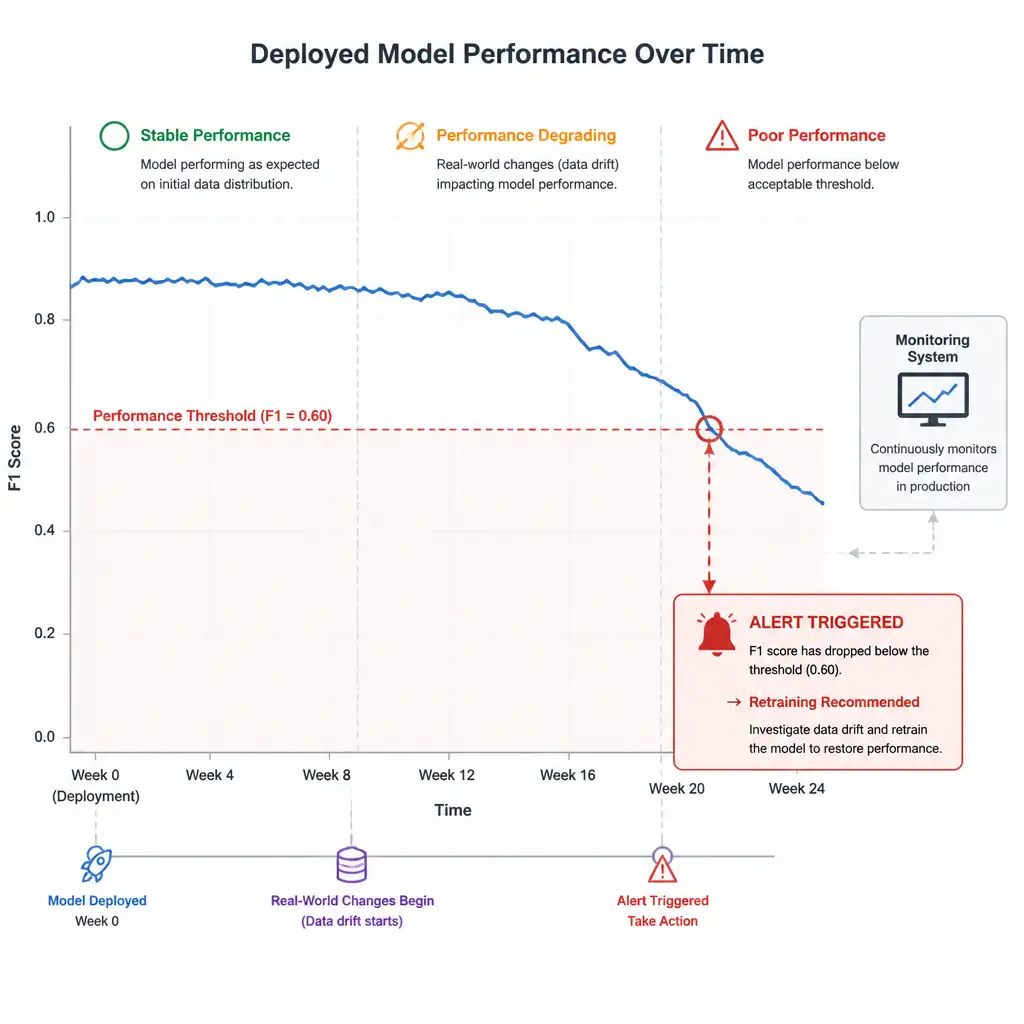
Deploying a model isn't a set-it-and-forget-it thing. You need continuous monitoring to catch performance degradation, concept drift, or operational failures early, so you can alert and retrain before customers notice.
Full Explanation
Continuous monitoring is a critical phase of the Machine Learning Lifecycle (MLOps). Unlike traditional software, machine learning systems are dynamic and depend heavily on real-world data feeds, which change over time. Once a model is deployed, its performance almost always degrades due to factors like data drift (changes in input data distributions) and concept drift (changes in the relationship between input features and target variables). By implementing continuous monitoring, organizations can track key metrics—such as inference latency, error rates, input distributions, and prediction accuracy. This allows teams to identify anomalies, silent failures, and model degradation early, triggering automated alerts or retraining pipelines before the business is negatively impacted.
Let's look at why the other choices are incorrect: - The option about verifying that the model is reading from the static training dataset rather than live inputs is incorrect because in production, the model must process live, incoming production inputs, not the static training dataset used during development. - The option about managing and logging the version history of the model's source code and configuration is handled by systems like Git or model registries (e.g., MLflow, DVC), not by runtime model monitoring tools. - The option about automatically optimizing and increasing the model's accuracy on its training data is not a function of monitoring. Monitoring observes and alerts on performance metrics; model optimization and retraining are separate processes triggered in response to monitoring alerts.