During the training of a neural network, a developer implements a learning rate scheduler (or planner). What is the primary purpose of this component?
Select an answer to reveal the explanation.
Short Explanation and Infographic
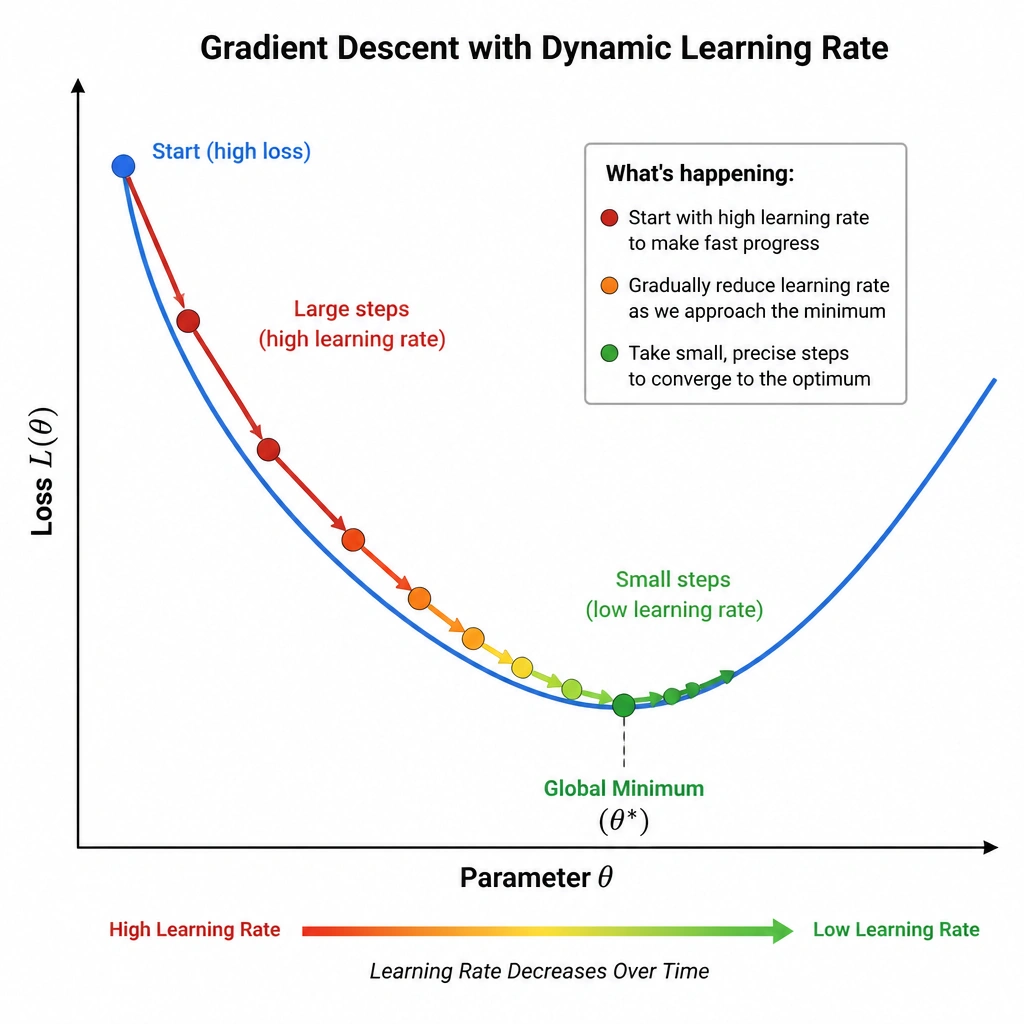
Think of the learning rate like your speed when you're driving a car toward a destination. If you drive too fast (a high learning rate), you might overshoot your destination and crash. If you drive too slow (a low learning rate), it'll take you forever to get there. A learning rate planner, or scheduler, is like a smart cruise control. It starts fast to cover ground quickly, but as you get closer to the destination—which is the minimum of your loss function—it slows down to make sure you land right on it. Adjusting that step size dynamically during training is how we get models to converge quickly and perform at their best. Got it? Sweet. Let's keep rolling!
Full explanation below image
Full Explanation
A learning rate scheduler (or planner) is used to adjust the learning rate during the training process according to a predefined schedule or based on validation metrics. The learning rate is a hyperparameter that controls how much the model's weights are updated in response to the estimated error gradient. If the learning rate is kept constant and is too high, the optimization algorithm may oscillate around the minimum or diverge. If it is too low, training will be prohibitively slow and may get trapped in suboptimal local minima. A learning rate planner adjusts the rate (e.g., using step decay, exponential decay, cosine annealing, or reduced learning rate on plateau) to start large for rapid progress and decrease over time to allow fine-tuning of the weights.
Let's review the incorrect options: - Selecting the optimizer (Option A) is a structural hyperparameter choice made by the developer before training (e.g., electing Adam, RMSprop, or SGD) and is not dynamically changed by a learning rate scheduler. - Increasing the number of epochs (Option C) is typically handled by early stopping mechanisms or static training configurations, not by the learning rate scheduler. - Model regularization (Option D), such as L1 (Lasso) and L2 (Ridge) weight decay, is a technique to penalize large weights to prevent overfitting, distinct from adjusting the learning rate step size.