
In the context of configuring a Convolutional Neural Network (CNN), what does the "stride" parameter define?
Select an answer to reveal the explanation.
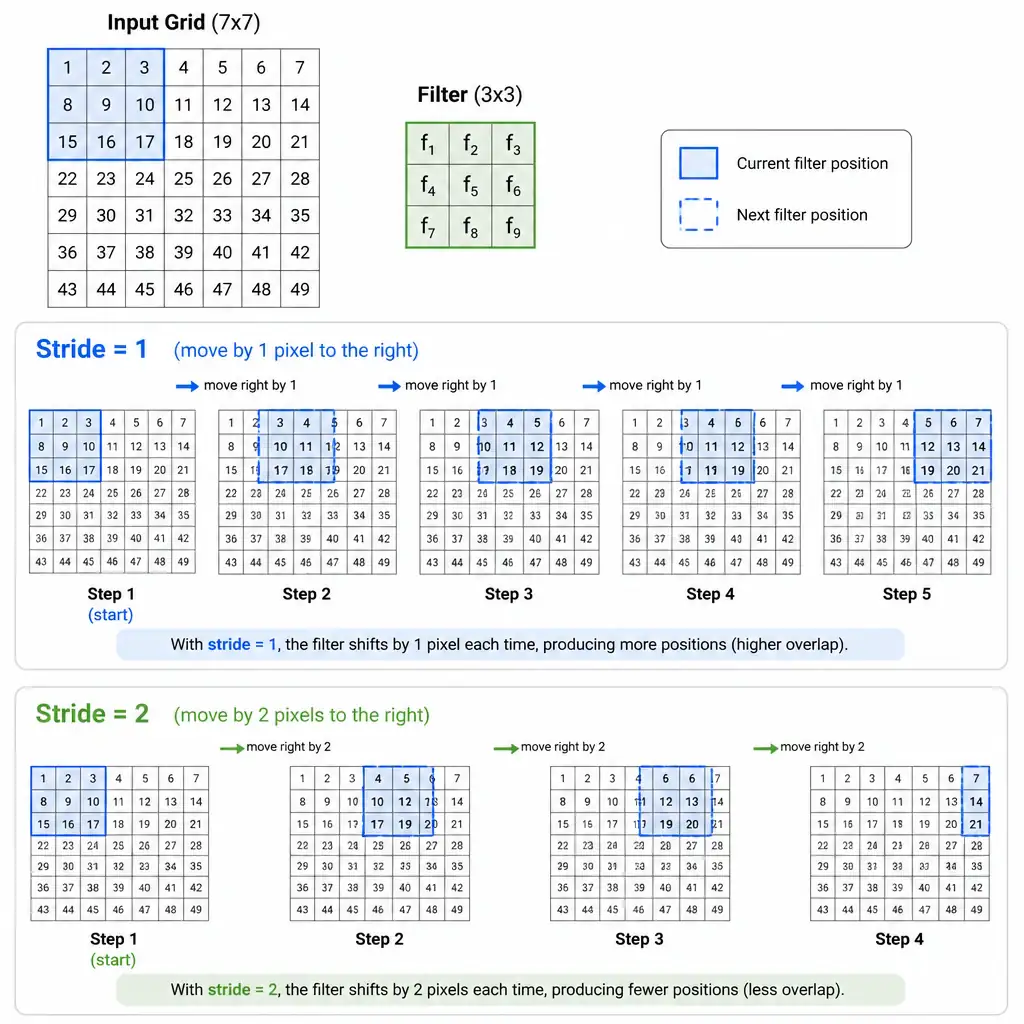
Short Explanation
Here's the deal: the stride tells you how many pixels the filter jumps each time it slides across the input image. A stride of 1 means one-pixel steps, while a stride of 2 means bigger jumps, a smaller output feature map, and faster traversal.
Full Explanation
In Convolutional Neural Networks (CNNs), the stride is a key hyperparameter for both convolutional and pooling layers. It determines how many pixels the filter/kernel shifts after completing a multiplication step. For instance, if the stride is set to 1, the filter moves one pixel at a time, producing highly overlapping feature extractions and a larger output map. If the stride is set to 2, the filter shifts by two pixels, which skips intermediate positions, downsamples the output spatial size by approximately half, and reduces computational complexity.
Let's check the other options: - The physical dimensions (width and height) of the sliding filter or kernel describes the kernel size (or filter size), which dictates the receptive field of the filter (e.g., 3x3 or 5x5 pixels), not how it moves. - The depth of the output feature map, determined by the count of filters, is controlled by the number of filters applied in that layer, which dictates the number of output channels (or depth) of the feature map. - The amount of zero-padding applied to the borders of the input image describes padding, which is the practice of adding extra pixels (typically zeros) around the border of the input image to control output shape and preserve edge information.
For the exam, make sure you remember that stride is the parameter controlling the step size of the filter's movement across the input.