
During production monitoring, an operations team notices that a deployed credit-scoring model is experiencing both data drift and model degradation. What is the distinction between these two phenomena?
Select an answer to reveal the explanation.
Short Explanation
If your boss says the credit model isn't working as well as it did six months ago, that's model degradation—its accuracy or precision is dropping. It often happens because data drift changed the input features, like income levels shifting during a recession. Fix the drift or retrain before the model keeps tanking.
Full Explanation
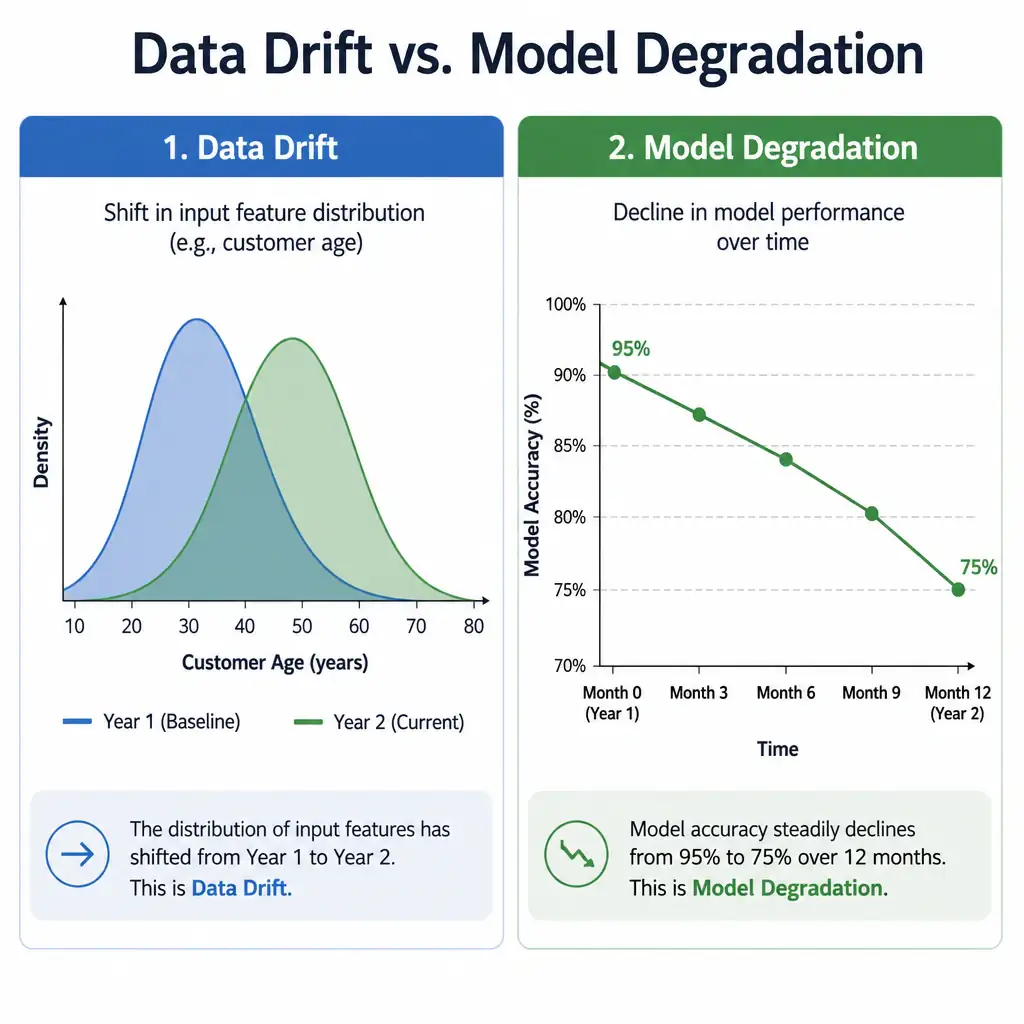
The correct distinction is that data drift refers to shifts in the statistical distribution of incoming input features, while model degradation refers to the decline in the model's predictive performance metrics. In machine learning lifecycle management (MLOps), monitoring deployed models requires understanding the difference between data drift and model degradation, as they represent different aspects of system health and require different remediation strategies.
Data drift, specifically covariate shift, occurs when the statistical properties of the input features change over time. Mathematically, the probability distribution of the input variables shifts. For example, if a recommendation engine was trained on data primarily from young adults but suddenly experiences an influx of older users, the input feature distribution, such as user age and browsing hours, has drifted. The model is now receiving inputs it was not adequately trained to handle.
Model degradation is the actual decline in the model's predictive performance, such as a drop in accuracy, precision, recall, or F1-score, over time. While model degradation is often a direct consequence of data drift, it can also be caused by concept drift. Concept drift occurs when the underlying relationship between the input features and the target label changes, even if the input distribution remains constant. For example, if consumer purchasing behavior changes due to a sudden macroeconomic shift, a model predicting purchase likelihood will experience degradation because its learned patterns are no longer valid.
The claim that data drift and model degradation are identical terms describing the exact same type of database storage failure is incorrect because they are distinct phenomena: data drift describes input data distribution changes, while model degradation describes the decline in output performance metrics, and neither is a database storage failure.
The claim that data drift is a static error that only occurs during data labeling in development, whereas model degradation is a hardware performance issue caused by CPU throttling, is incorrect because data drift is a dynamic production phenomenon, not a development labeling error, and model degradation is an algorithmic performance metric issue, not a hardware throttling issue.
The claim that data drift measures the speed at which predictions are served, while model degradation measures the size of the model binary file, is incorrect because it confuses data drift and model degradation with latency and storage footprints, which are infrastructure resource metrics rather than machine learning statistical performance metrics.