
When designing a high-performance training pipeline for large datasets in TensorFlow, what is the primary role of the tf.data API?
Select an answer to reveal the explanation.
Short Explanation
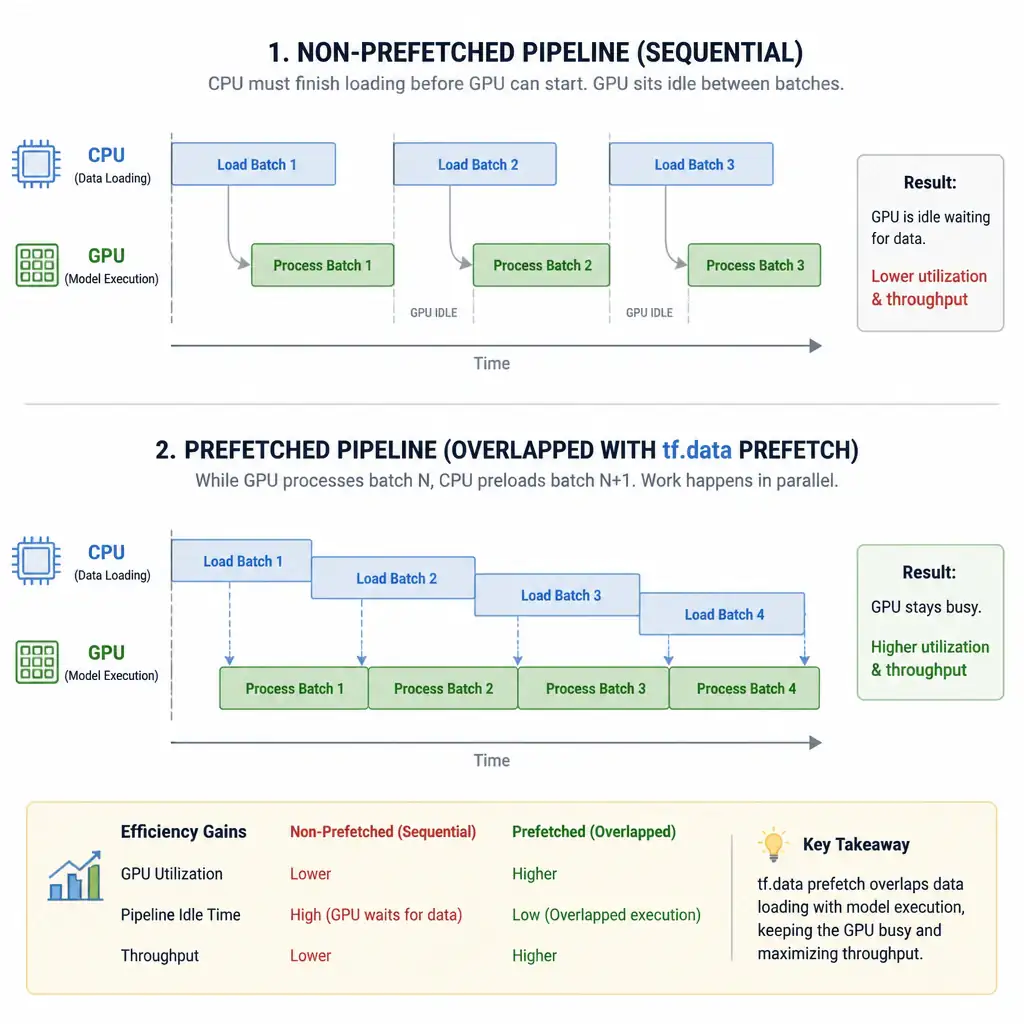
Imagine your boss walks in and says they just bought a fleet of top-of-the-line GPUs for AI training. You set up your training loop, but the GPUs sit idle because the CPU can't load and preprocess data fast enough. The tf.data API fixes that by building a smart conveyor belt that loads, transforms, and prefetches batches so the accelerator always has work, which is why the efficient input pipeline answer is correct.
Full Explanation
In deep learning, training speed is often limited by data delivery rather than computation. A GPU can execute a forward and backward pass much faster than a CPU can load, decode, and preprocess data from a hard drive. This is known as the input bottleneck. The tf.data API provides the tools necessary to build input pipelines that operate asynchronously. By abstracting data as a tf.data.Dataset object, developers can chain together performance-optimized operations: .map() applies transformations such as normalization or augmentation across multiple CPU threads; .batch() groups consecutive elements of the dataset into batches; .shuffle() randomizes the order of dataset elements; and .prefetch() overlaps the preprocessing work of the CPU with the model training work of the accelerator, such as a GPU or TPU. While the accelerator is training on the current batch, the CPU is already reading and preprocessing the next batch in the background. That is why the correct choice is the one that describes constructing efficient input pipelines that load, preprocess, and stream data asynchronously to prevent hardware bottlenecks. The distractor about serializing the model architecture and saving trained weights into a standardized file format is wrong because that is handled by APIs like tf.saved_model or model.save(). The distractor about automatically optimizing neural network hyperparameter values, such as learning rate and batch size, is wrong because hyperparameter tuning is typically managed by libraries like KerasTuner, not the data loading API. The distractor about executing post-training model evaluations and printing accuracy metrics is wrong because model evaluation is performed by methods like model.evaluate().