When preparing raw natural language text for training or inference with a Transformer model in the Hugging Face transformers library, what is the fundamental purpose of the tokenizer?
Select an answer to reveal the explanation.
Short Explanation and Infographic
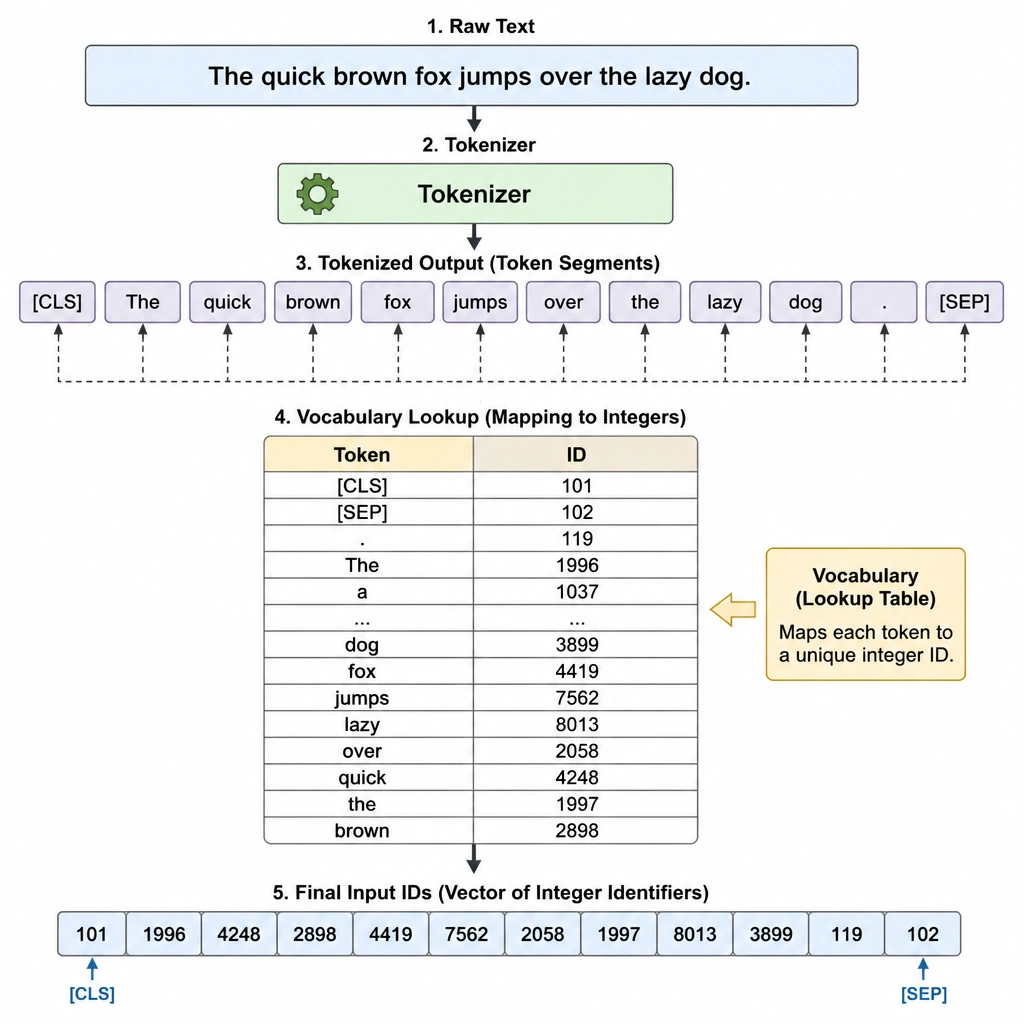
Check this out: computer models are brilliant at linear algebra, but they can't read a single word of human text. If you try to feed a raw sentence straight into a Transformer, it'll just throw an error and stall. That's why the tokenizer is your best friend here. Think of it like a translator that takes your text, chops it up into manageable pieces (which we call tokens), maps those pieces to unique numerical IDs from its vocabulary list, and then appends special tokens—like start-of-sequence or padding tokens—so the model knows exactly where the text begins and ends. Without this step, the model is completely blind. Option A is the correct answer.
Full explanation below image
Full Explanation
In the Hugging Face ecosystem and modern natural language processing workflows, tokenizers are critical preprocessing tools that bridge the gap between raw text and model-compatible tensors. Transformer models, mathematically, operate on multi-dimensional numeric matrices. The tokenization process involves three main phases: 1. Normalization and Pre-tokenization: The text is cleaned (e.g., removing whitespace, lowercasing) and split into preliminary units. 2. Subword Tokenization: The text is segmented into tokens using algorithms such as Byte-Pair Encoding (BPE), WordPiece, or SentencePiece. This subword approach allows the vocabulary to remain relatively small while avoiding out-of-vocabulary (OOV) errors, as unseen words can be broken down into known sub-parts. 3. Numericalization: Tokens are mapped to their corresponding numerical integer IDs based on the model's pre-trained vocabulary. The tokenizer also adds model-specific special tokens (such as [CLS] and [SEP] for BERT, or <s> and </s> for RoBERTa) which act as control markers for classification or sequence boundaries.
Let's review the other options: - Option B refers to the creation of contextual embeddings. This is handled by the model's internal embedding and attention layers during the forward pass, not by the tokenizer. - Option C describes optimization and weight updating, which are tasks performed by the optimizer (e.g., AdamW) and the backpropagation engine, not the preprocessing tokenizer. - Option D describes data augmentation, which is an optional step in data preparation and is not the core function of a tokenizer.