In modern Natural Language Processing (NLP), how are word embeddings (such as Word2Vec, GloVe, or FastText) typically utilized in downstream applications?
Select an answer to reveal the explanation.
Short Explanation and Infographic
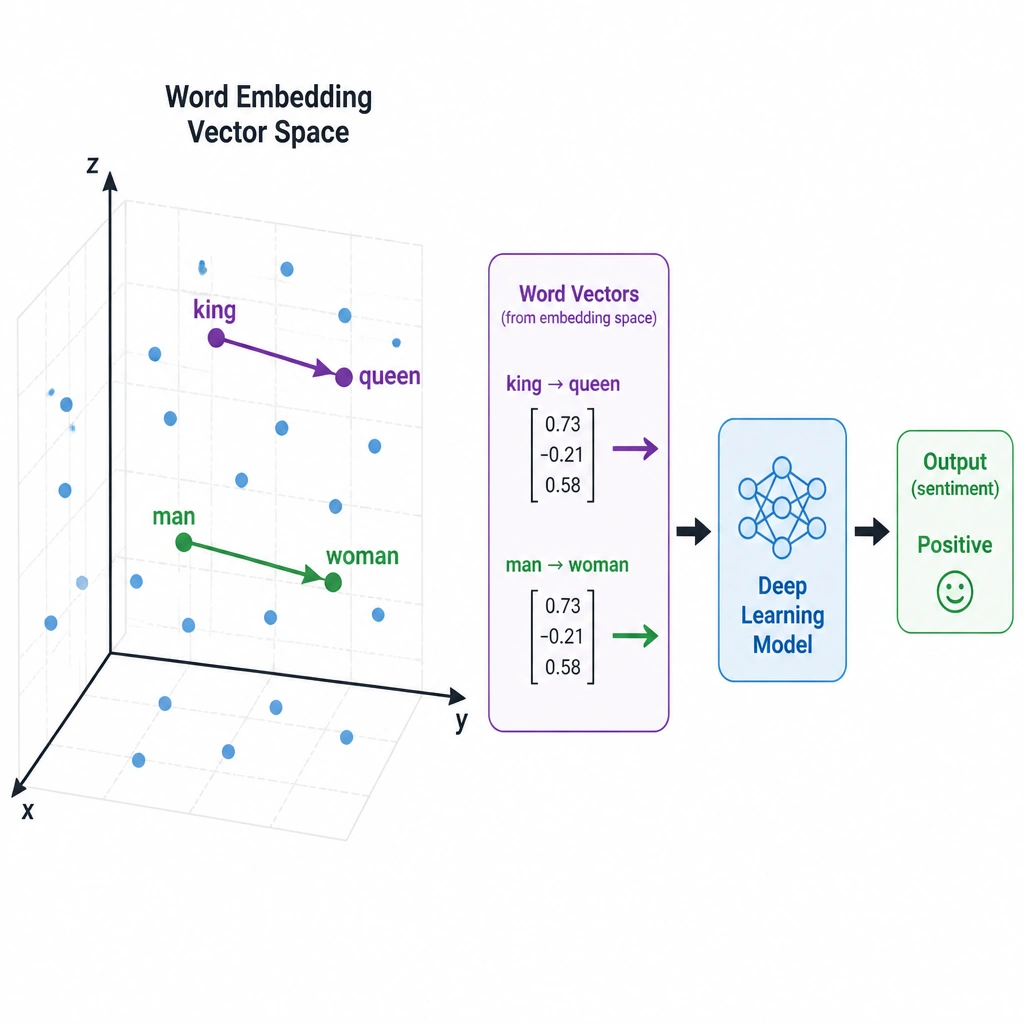
Think of it like this: computers don't understand words, they only understand numbers. If you feed a neural network the raw word 'apple', it doesn't know what to do with it. That's where word embeddings come in. They map words into a multi-dimensional space, where words with similar meanings (like 'apple' and 'pear') end up close together. We use these dense vector coordinates as the input features for our deep learning models. That way, when the model is doing sentiment analysis or translating text, it actually understands the relationship between words. Pretty cool, right?
Full explanation below image
Full Explanation
Word embeddings are a class of techniques in NLP where individual words are mapped to real-valued vectors in a continuous vector space. The key property of word embeddings is that words with similar meanings or semantic contexts are mapped to vectors that are geometrically close to one another (using metrics like cosine similarity).
In downstream applications, word embeddings serve as the fundamental input layer for deep learning models. Instead of using high-dimensional, sparse representations like one-hot encoding (where a vocabulary of 50,000 words requires 50,000-dimensional vectors with a single '1'), word embeddings compress words into dense, lower-dimensional vectors (typically 100 to 768 dimensions). These dense vectors capture semantic relationships and are fed as input features into recurrent neural networks (RNNs), convolutional neural networks (CNNs), or transformer architectures to perform complex tasks such as sentiment analysis, machine translation, named entity recognition, and question answering.
Let's look at the incorrect options: - Option A is incorrect because word embeddings represent linguistic units (words) and are not used as inputs for image classification models, which process pixel matrices. - Option B is incorrect because reinforcement learning policy networks use state observations (like positions, velocities, or raw pixels) to select actions, rather than utilizing word embeddings. - Option D is incorrect because database indexing is a computer science data structures problem (typically solved with B-Trees or Hash tables) to accelerate queries, not a semantic NLP embedding task.