
When using statistical methods to represent document content, how does a Term Frequency-Inverse Document Frequency (TF-IDF) model improve upon a standard Bag-of-Words (BoW) representation?
Select an answer to reveal the explanation.
Short Explanation
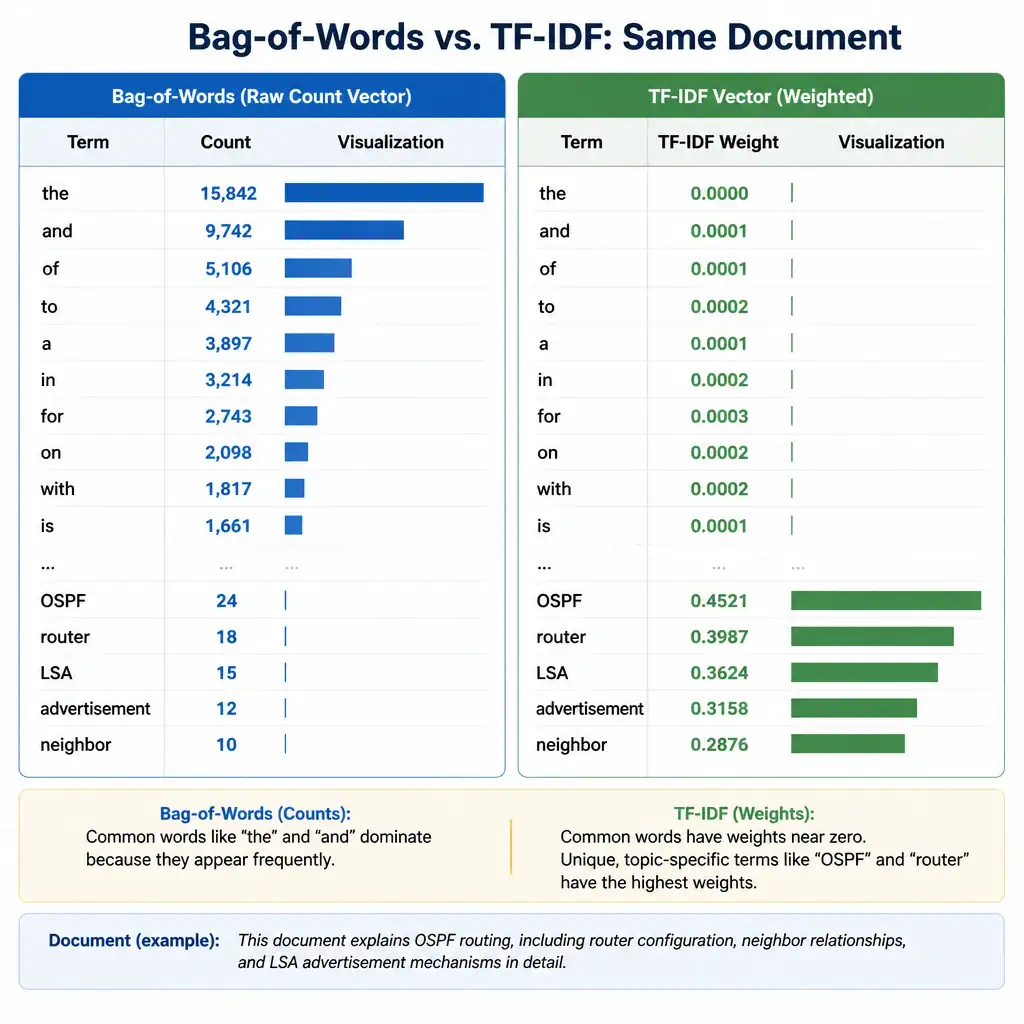
TF-IDF improves Bag-of-Words by still counting terms, then scaling them by how rare they are across the corpus. That pushes down filler words like 'the' and boosts distinctive terms like 'BGP' or 'subnet', so your model focuses on meaning instead of noise.
Full Explanation
The correct choice is the statement that TF-IDF weights terms based on their rarity across the entire document corpus, downplaying common filler words. Both Bag-of-Words and Term Frequency-Inverse Document Frequency are statistical vector space models used to represent text, but they differ in how they calculate token importance. Bag-of-Words represents a document by creating a vocabulary list and counting the occurrences of each word, which is the term frequency. The primary issue with Bag-of-Words is that it treats all words equally. High-frequency filler words, such as 'and', 'the', or domain-specific words common to the entire corpus, dominate the representation even though they carry little discriminative information. TF-IDF addresses this limitation by introducing a weighting factor: inverse document frequency. The TF-IDF score is the term frequency multiplied by the inverse document frequency, which is the log of the total number of documents divided by the number of documents containing the term. The inverse document frequency term scales down the weight of words that appear frequently across all documents, reducing the influence of stop words and filler words, and scales up the weight of rare terms that appear only in a small subset of documents. This ensures that the resulting vectors highlight terms that are uniquely characteristic of each document. The statement that TF-IDF incorporates word order and grammatical sequence rules to capture sentence structure is incorrect because both Bag-of-Words and TF-IDF are bag models, meaning they discard word order and grammatical structure. The statement that TF-IDF maps words to low-dimensional dense vectors using a pre-trained neural network is incorrect because TF-IDF is a statistical, frequency-based representation and does not use neural networks or low-dimensional dense embeddings. The statement that TF-IDF converts text documents into hierarchical tree structures that show subject-object relationships is incorrect because TF-IDF represents documents as flat frequency vectors, not hierarchical trees representing grammatical relationships.