
A software engineering team is building an enterprise-grade document processing service that must extract named entities from millions of customer support emails daily. Why would the team choose the spaCy library for this production pipeline instead of other educational NLP toolkits?
Select an answer to reveal the explanation.
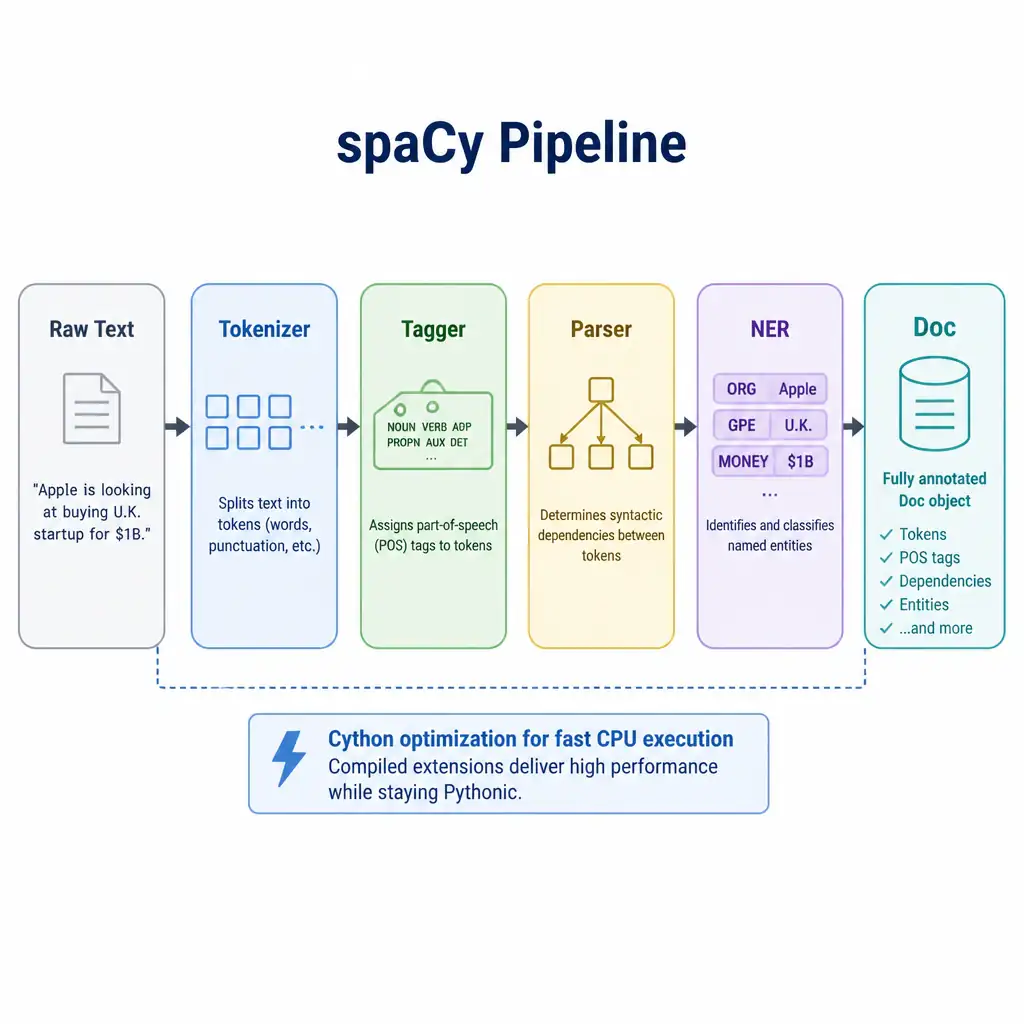
Short Explanation
Here's the deal—when you need to process millions of emails daily, you want spaCy because it's built for industrial-strength NLP. It uses fast, compiled Cython extensions to run end-to-end pipelines quickly and reliably. In production, speed and consistency matter, and spaCy delivers both.
Full Explanation
In NLP development, choosing the right tool depends heavily on the production environment's requirements. Academic libraries, such as the Natural Language Toolkit (NLTK), are designed for education and research, providing a wide array of experimental algorithms but often lacking optimization for speed and scale.
spaCy, on the other hand, is specifically designed as an "industrial-strength" library for production environments. Its core features include: 1. High-speed execution: Much of spaCy’s underlying code is written in Cython, which compiles directly to C, making operations like tokenization, part-of-speech tagging, and named entity recognition (NER) significantly faster than pure Python alternatives. 2. Direct pipeline integration: spaCy uses a standardized Doc object and a pipeline architecture (nlp(text)), which processes raw text and passes it through tokenizers, taggers, parsers, and entity recognizers sequentially and efficiently. 3. Opinionated design: Instead of offering multiple alternative implementations for a single task, spaCy provides a single, state-of-the-art implementation, reducing design decisions for developers and ensuring consistency.
Therefore, the correct answer is the statement that spaCy is optimized for industrial-strength performance, offering fast, compiled C-extensions for end-to-end NLP pipelines.
Let's evaluate the incorrect options: - The claim that spaCy runs exclusively in web browsers using client-side JavaScript is incorrect because spaCy is a Python library typically run on the server side, not a client-side JavaScript library. - The claim that spaCy is a minimal scripting library that requires no pre-trained language models or external memory resources is incorrect because spaCy relies on downloadable, pre-trained statistical and transformer-based models which require significant memory and disk space to load. - The claim that spaCy is restricted strictly to Python 2 syntax, making it compatible with legacy mainframe operating systems, is incorrect because modern versions of spaCy are compatible with Python 3 and have dropped support for Python 2.