
A company is deploying an AI-powered conversational voice assistant designed to handle customer inquiries in real time. During testing, users report that the assistant either responds too slowly or completely misinterprets their commands. Which of the following describes the primary technical challenge in designing real-time interactive NLU systems?
Select an answer to reveal the explanation.
Short Explanation
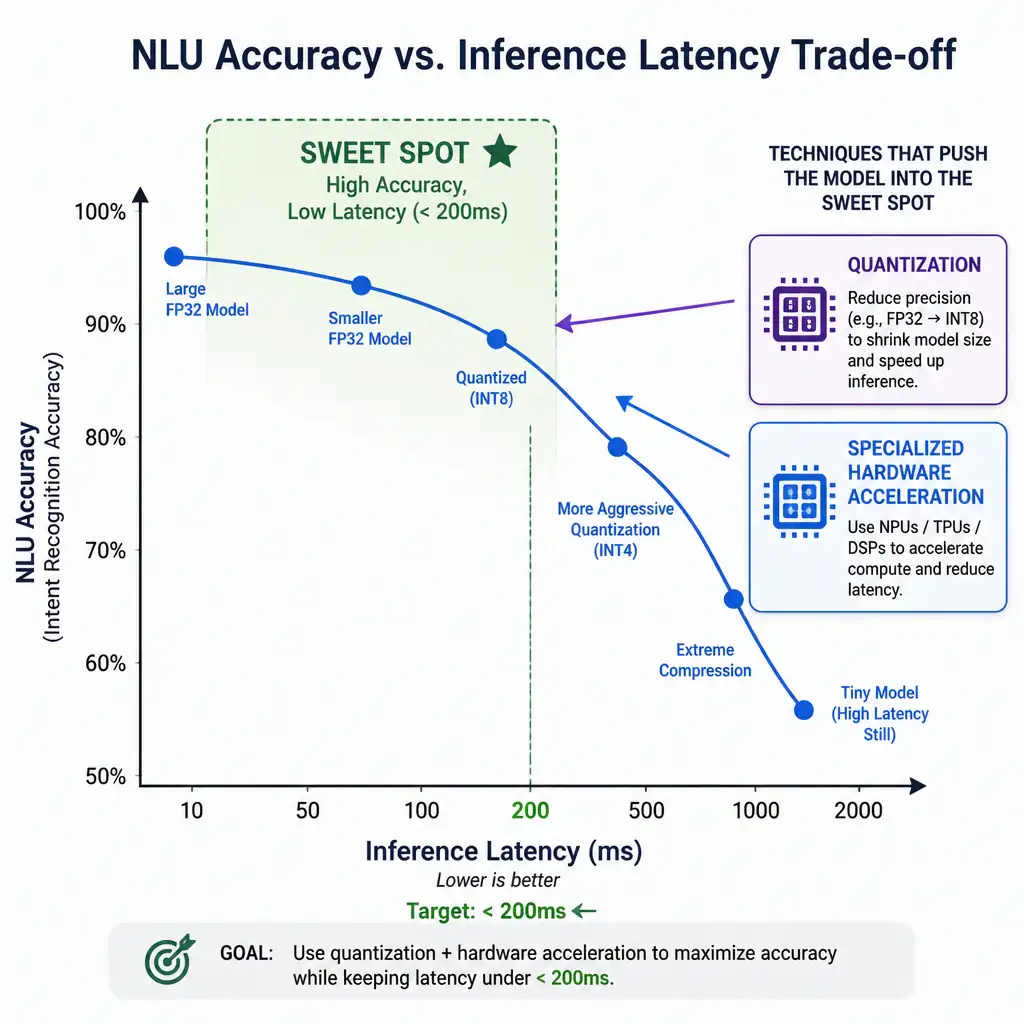
If you've ever used a voice assistant that took too long or answered weirdly, you've hit this trade-off. You need low latency to keep the conversation natural while still understanding commands accurately. That's the core challenge in real-time NLU.
Full Explanation
Designing real-time conversational AI assistants presents a fundamental engineering trade-off between natural language understanding accuracy and inference latency. For a conversation to feel natural to human users, the end-to-end latency—including speech-to-text conversion, NLU inference, response generation, and text-to-speech synthesis—must ideally remain below 200 to 300 milliseconds. NLU tasks require deep neural networks, such as Transformer-based models, to parse syntax, resolve ambiguity, and extract semantic intent from user queries. However, these complex architectures demand significant computational resources, leading to higher inference times. Reducing latency by using smaller models or aggressive optimization techniques, such as weight quantization or model pruning, often results in a loss of semantic precision, causing the model to misinterpret user intents or make errors. Therefore, maintaining low latency to keep conversations natural while achieving high accuracy in natural language understanding is the primary technical challenge.
The option about ensuring the model is large enough to memorize every possible user query is incorrect because memorizing every possible query is impossible due to the infinite variety of natural language; NLU models must generalize rather than memorize. The option about restricting user inputs to single-word commands is incorrect because it defeats the purpose of natural language understanding and results in a poor user experience. The option about relying exclusively on rule-based keyword matching is incorrect because keyword matching lacks the capacity to understand context, synonyms, or complex intent, making it unsuitable for modern intelligent assistants. Thus, managing the dual requirements of low latency and high accuracy is the primary technical bottleneck in production NLU systems.