
When interacting with a Large Language Model (LLM) to solve a task, what is the meaning of 'zero-shot learning' or 'zero-shot prompt design'?
Select an answer to reveal the explanation.
Short Explanation
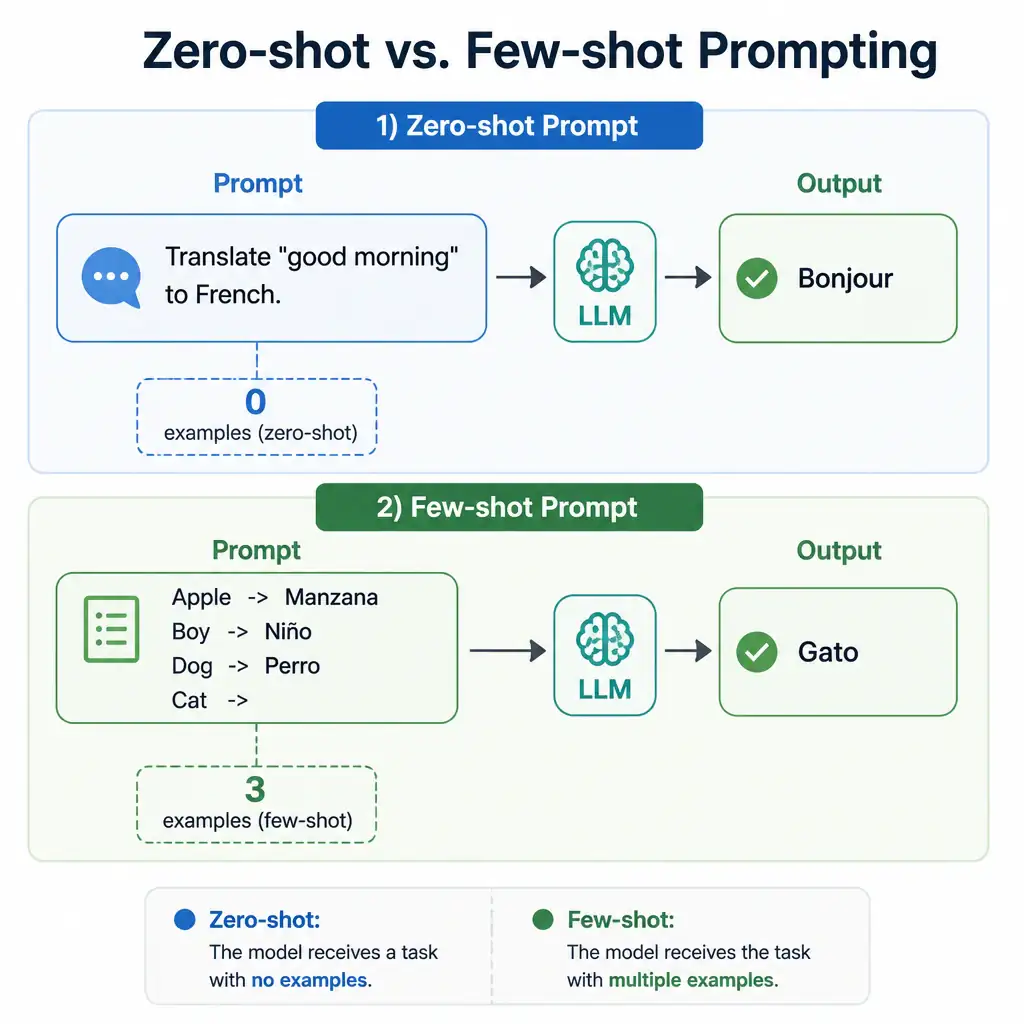
Here's the deal: when you ask a large language model to do something, zero-shot means it does the task right away from a descriptive prompt without any input-output examples. You're not feeding it examples first; it's relying on what it learned during pre-training.
Full Explanation
Zero-shot learning in the context of large language models refers to the model's ability to perform a task without having received any specific training examples for that task. This capability arises from the model's extensive pre-training on diverse, multi-domain text corpora, which allows it to develop a generalized understanding of grammar, semantics, logic, and instructions.
During inference, the user provides a prompt containing a description of the task, such as 'Extract the names of companies from this press release:', followed by the input text. The model processes the instruction and generates the correct output without any gradient updates or weight modifications. This is contrasted with few-shot learning, where a small number of demonstration examples, meaning input-output pairs, are included in the prompt to guide the model's output formatting or style. It is also contrasted with fine-tuning, which involves training the model on thousands of examples to modify its weights.
The correct meaning is that the model successfully executes a task immediately upon receiving a descriptive prompt, without being provided with any input-output examples. The idea that the model is built from scratch and trained on a completely empty dataset to prevent learning bias is incorrect because training on zero data is impossible; models require data to learn weights and structure. The idea that the model has been compressed to zero layers and parameters to run locally on low-power devices is incorrect because a model with zero parameters cannot function or hold any mathematical representations. The idea that the model's temperature is set to zero, preventing it from generating any output text, is incorrect because setting a model's temperature to zero makes its outputs deterministic, always picking the highest probability token, but does not define zero-shot learning.
For your exam, associate zero-shot learning with executing a task based solely on instruction in the prompt, with no examples provided.