What is the primary purpose of the self-attention mechanism in a Transformer-based neural network architecture?
Select an answer to reveal the explanation.
Short Explanation and Infographic
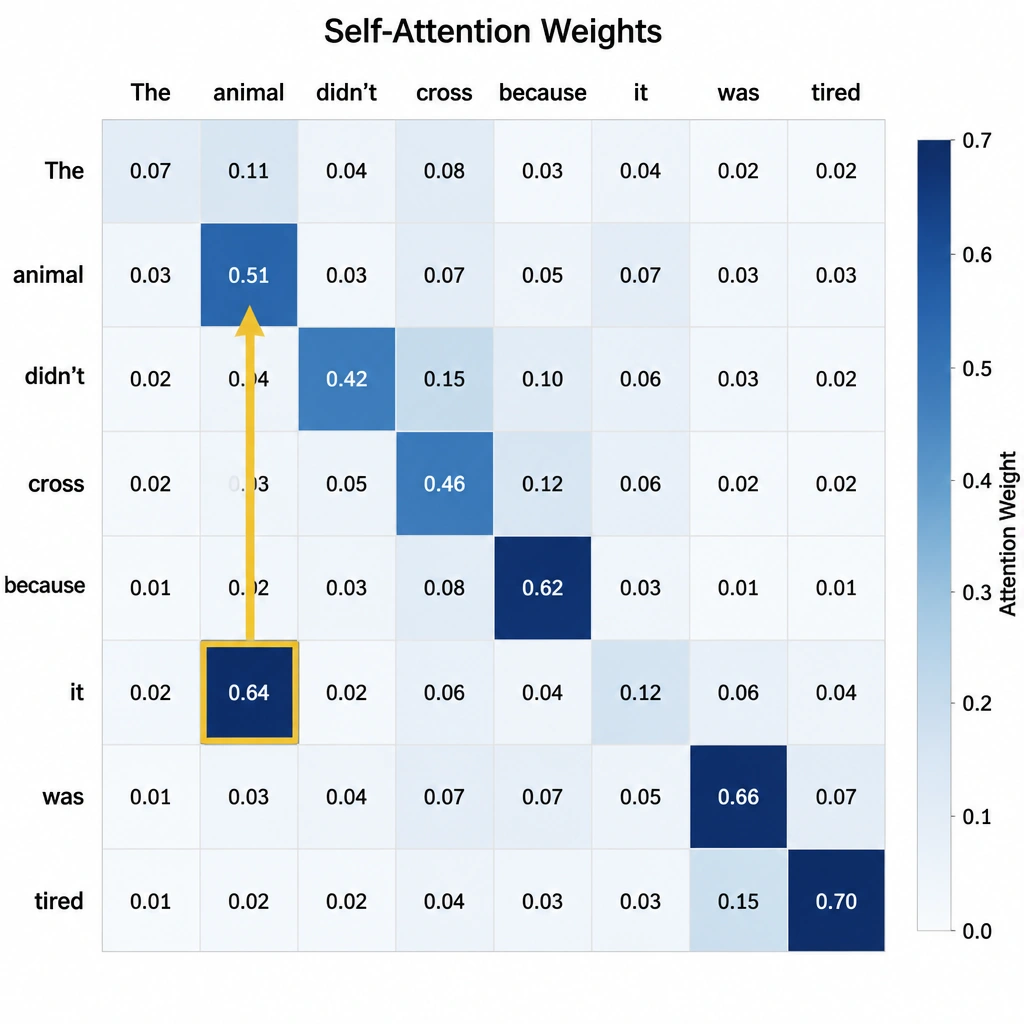
Here's the deal with self-attention—it's the magic that makes Transformers so powerful. In older systems, words were processed one by one. But with self-attention, when the model looks at a word, it looks at every other word in the sentence at the same time and assigns weights. It asks, 'Which of these other words are most important to understanding this current word?' For example, in the sentence 'The bank of the river was muddy,' self-attention connects 'bank' directly to 'river' and 'muddy' to figure out it's a piece of land, not a financial institution. It captures these relationships instantly, even if the words are far apart. It's not about filtering stop words or compressing dimensions.
Full explanation below image
Full Explanation
The self-attention mechanism is the foundational component of the Transformer architecture, introduced by Vaswani et al. in 2017. Before Transformers, sequence processing relied on Recurrent Neural Networks (RNNs) or LSTMs, which processed tokens sequentially from left to right. This sequential dependency created a bottleneck: it made parallel training impossible and struggled to retain context over long distances due to the vanishing gradient problem.
Self-attention addresses these limitations by allowing a model to process the entire sequence of tokens simultaneously. When encoding a specific target word, the self-attention mechanism dynamically calculates attention weights for every other word in the sequence, measuring how much focus should be placed on them to capture the target word's context. Internally, each input token's embedding is projected into three vectors: Query (Q), Key (K), and Value (V). The model calculates dot-products between Queries and Keys to produce attention scores, which are scaled and passed through a softmax function to create a weight distribution. These weights are multiplied by the Value vectors to produce a context-aware representation of the target word. This process allows the network to capture long-range dependencies and handle homographs effortlessly.
Let's review the incorrect options: - Option A describes the sequential processing characteristic of RNNs. Transformers avoid sequential processing, using positional encodings instead to maintain token order while processing in parallel. - Option C is incorrect because self-attention does not compress embeddings; instead, it outputs vectors of the same dimensionality that incorporate context from the rest of the sequence. - Option D describes stop-word removal, which is a pre-processing step that is completely unrelated to the attention mechanisms inside neural networks.