A company is designing an interactive customer service assistant. The system must parse user inputs (e.g., 'I want to cancel my subscription') and correctly map them to specific intents or actions. Which subfield of NLP is primarily responsible for parsing and understanding these user intents?
Select an answer to reveal the explanation.
Short Explanation and Infographic
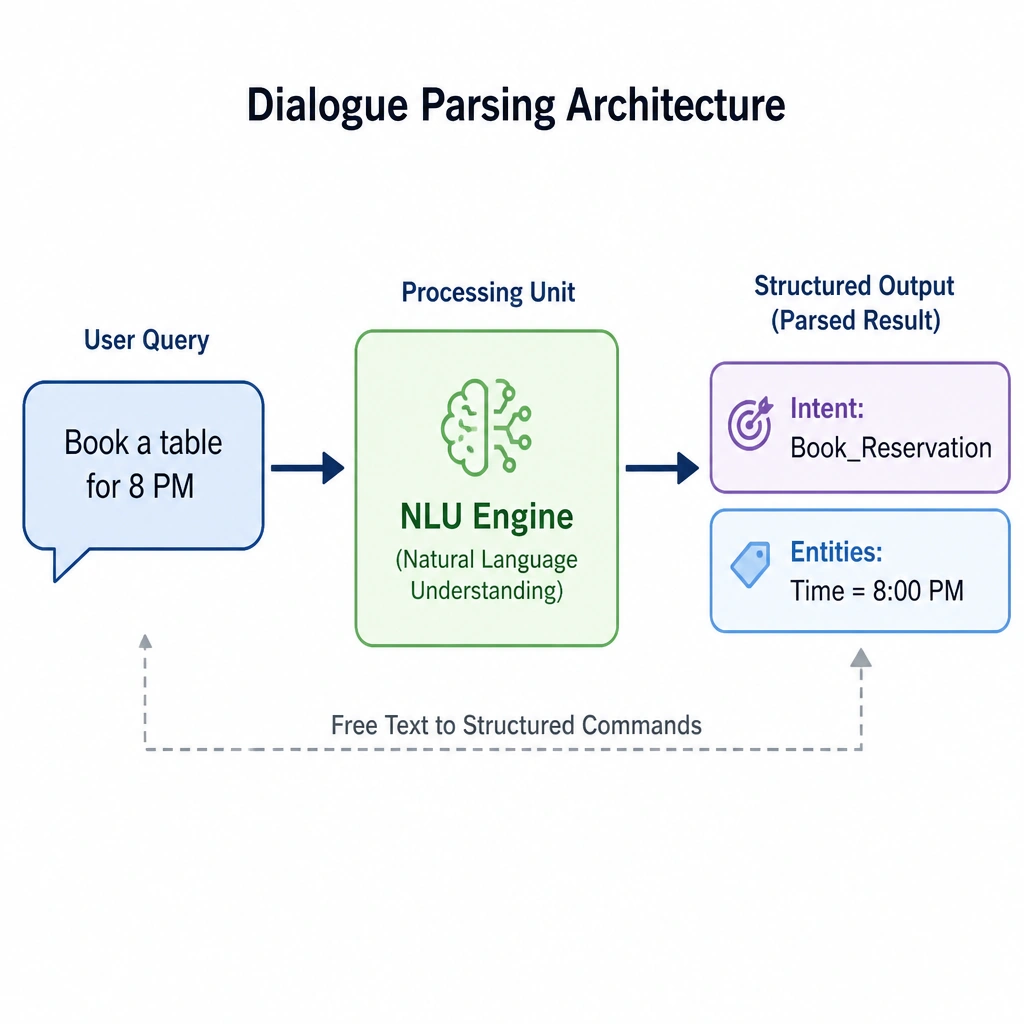
Think about this: when a user types 'shut down my account' or 'I need to close my membership,' they're saying different words but they mean the exact same thing. A chatbot needs to understand that underlying intent. That's the job of Natural Language Understanding, or NLU. NLU is a specialized subfield of NLP that focuses on reading comprehension and figuring out meaning, intent, and entities. Sentiment analysis just tells you if they're happy or mad, NLG is about generating new text, and NER extracts specific names or dates. For mapping a user's typed message to a computer command, NLU is what you want.
Full explanation below image
Full Explanation
Natural Language Understanding (NLU) is a specialized subfield under the broader umbrella of Natural Language Processing (NLP). While NLP refers to any interaction between computers and human languages—including simple text cleanup, tokenization, and formatting—NLU specifically focuses on machine reading comprehension. Its main objective is to interpret the meaning, semantic intent, and context behind user input.
In conversational AI and chatbot design, NLU is the critical engine that translates unstructured human dialogue into structured data that a software backend can execute. For example, if a user inputs the phrase 'Can you update my shipping address to 123 Main St?', the NLU system performs two essential tasks: 1. Intent Recognition: Identifying the user's goal (e.g., update_address). 2. Entity Extraction: Identifying key variables within the input (e.g., address_value = 123 Main St). By extracting these components, NLU enables the system to trigger the correct API call.
Let's look at why the other choices are incorrect: - Natural Language Generation (NLG) (Option A) is the counterpart to NLU. Instead of reading or understanding text, NLG focuses on generating coherent, human-like text from structured data or prompts (e.g., writing the chatbot's response). - Sentiment Analysis (Option B) is an NLP classification task that determines the emotional tone (positive, negative, neutral) of a text, but it does not map text to functional actions or parse complex intents. - Named Entity Recognition (Option D) is a subtask of NLU focused purely on identifying and categorizing entities (like names of people, companies, or locations) in text, but it does not determine the overall intent of the user's query.